Quantum Artificial Intelligence: A Comprehensive Review of Architectures, Applications, Challenges, and Future Directions
DOI:
https://doi.org/10.5281/zenodo.20542043Keywords:
Quantum Computing, Quantum Artificial Intelligence, Quantum Neural Network, Quantum Machine Learning, NISQ Computing, Quantum Literature SurveyAbstract
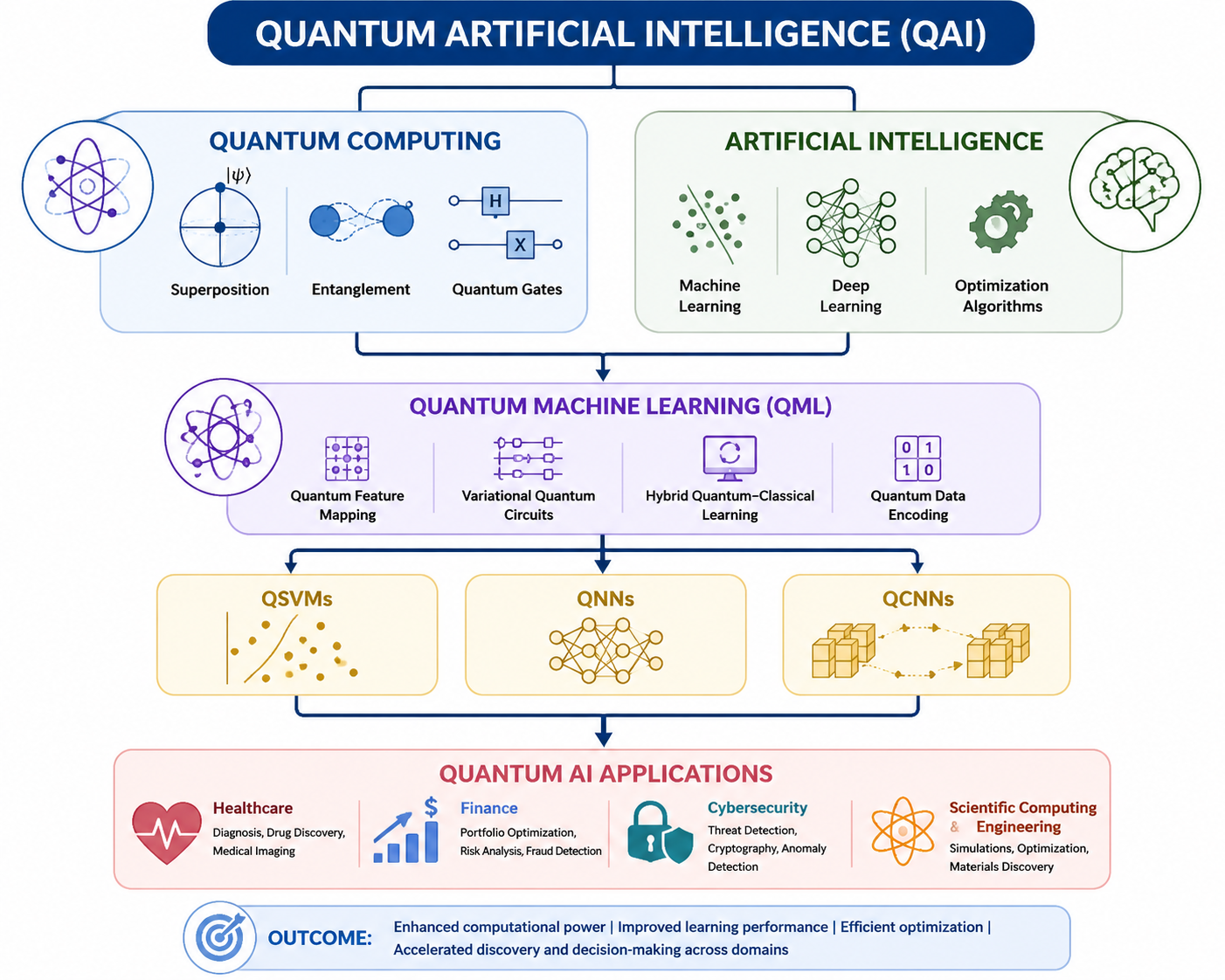
The field of Quantum Artificial Intelligence (Quantum AI) has emerged as a promising interdisciplinary research area where the computational power of quantum computing is merged with the learning and decision-making power of AI. The application of quantum principles such as superposition, entanglement and quantum interference to machine learning algorithms has created new possibilities for solving problems that may be difficult to solve by classical machines. In the last few years, advances in Noisy Intermediate-Scale Quantum (NISQ) devices have helped to speed advances in Quantum Machine Learning (QML) algorithms, Quantum Neural Networks (QNNs), Quantum Support Vector Machines (QSVMs), Quantum Convolutional Neural Networks (QCNNs) and hybrid learning algorithms. This review provides a comprehensive overview of the research in the field of Quantum AI from 2020 to 2026, covering the key concepts, novel architectures, algorithmic advancements, and practical applications. A critical assessment of the application of Quantum AI in fields such as healthcare, finance, cybersecurity, scientific computing and optimization problems is provided, and the benefits of quantum-enhanced learning models are discussed. In addition, common difficulties such as quantum hardware limitations, sensitivity to noise, encoding of data, scalability constraints and a lack of speed in training variational quantum circuits are discussed. The review also covers new avenues of research, including trustworthy quantum machine learning, explainable Quantum AI, quantum federated learning, and fault-tolerant quantum computing. The results suggest while practical large-scale deployment is currently limited by existing hardware capabilities, hybrid quantum-classical systems have great potential to rapidly move intelligent data processing and develop next-generation AI systems.
References
[1] Abbas, A., Sutter, D., Zoufal, C., Lucchi, A., Figalli, A. and Woerner, S. (2021) ‘The power of quantum neural networks’, Nature Computational Science, 1(6), pp.403–409. DOI: https://doi.org/10.1038/s43588-021-00084-1
[2] Bharti, K., Cervera-Lierta, A., Kyaw, T.H. et al. (2022) ‘Noisy intermediate-scale quantum algorithms’, Reviews of Modern Physics, 94(1), 015004. DOI: https://doi.org/10.1103/RevModPhys.94.015004
[3] Biamonte, J., Wittek, P., Pancotti, N., Rebentrost, P., Wiebe, N. and Lloyd, S. (2020) ‘Quantum machine learning’, Nature, 549(7671), pp.195–202. DOI: https://doi.org/10.1038/nature23474
[4] Buonaiuto, G., Guarasci, R., Minutolo, A., De Pietro, G. and Esposito, M. (2024) ‘Quantum transfer learning for acceptability judgements’, Quantum Machine Intelligence, 6(13). DOI: https://doi.org/10.1007/s42484-024-00141-8
[5] Catak, F.O., Seo, J. and Cali, U. (2025) ‘Trustworthy Quantum Machine Learning: A Roadmap for Reliability, Robustness and Security in the NISQ Era’, arXiv. DOI: https://doi.org/10.48550/arXiv.2511.02602
[6] Cerezo, M., Arrasmith, A., Babbush, R. et al. (2021) ‘Variational quantum algorithms’, Nature Reviews Physics, 3(9), pp.625–644. DOI: https://doi.org/10.1038/s42254-021-00348-9
[7] Devadas, R.M. and Sowmya, T. (2025) ‘Quantum machine learning: A comprehensive review of integrating AI with quantum computing’, MethodsX, 14, 103318. DOI: https://doi.org/10.1016/j.mex.2025.103318
[8] Gupta, R.S., Wood, C.E., Engstrom, T., Pole, J.D. and Shrapnel, S. (2025) ‘Quantum machine learning for digital health: A systematic review’, npj Digital Medicine, 8. DOI: https://doi.org/10.1038/s41746-025-01597-z
[9] Havlíček, V., Córcoles, A.D., Temme, K. et al. (2020) ‘Supervised learning with quantum-enhanced feature spaces’, Nature, 567(7747), pp.209–212. DOI: https://doi.org/10.1038/s41586-019-0980-2
[10] Jerbi, S., Gyurik, C., Marshall, S.C. et al. (2024) ‘Shadows of quantum machine learning’, Nature Communications, 15, 5676. DOI: https://doi.org/10.1038/s41467-024-49877-8
[11] Klusch, M., Lässig, J., Müssig, D., Macaluso, A. and Wilhelm, F.K. (2024) ‘Quantum Artificial Intelligence: A Brief Survey’, KI-Künstliche Intelligenz, 38, pp.257–276. DOI: https://doi.org/10.1007/s13218-024-00871-8
[12] Lloyd, S., Mohseni, M. and Rebentrost, P. (2020) ‘Quantum algorithms for supervised and unsupervised machine learning’, arXiv. DOI: https://doi.org/10.48550/arXiv.1307.0411
[13] Peral-García, D., Cruz-Benito, J. and García-Peñalvo, F.J. (2024) ‘Systematic literature review: Quantum machine learning and its applications’, Computer Science Review, 51, 100619. DOI: https://doi.org/10.1016/j.cosrev.2024.100619
[14] Rebentrost, P., Mohseni, M. and Lloyd, S. (2020) ‘Quantum support vector machine for big data classification’, Physical Review Letters, 113(13). DOI: https://doi.org/10.1103/PhysRevLett.113.130503
[15] Revythi, M. and Koukiou, G. (2025) ‘Quantum Machine Learning and Deep Learning: Fundamentals, Algorithms, Techniques and Real-World Applications’, Machine Learning and Knowledge Extraction, 7(3). DOI: https://doi.org/10.3390/make7030075
[16] Schuld, M. and Killoran, N. (2020) ‘Quantum machine learning in feature Hilbert spaces’, Physical Review Letters, 122(4). DOI: https://doi.org/10.1103/PhysRevLett.122.040504
[17] Ballester, R., Cerquides, J. and Artiles, L. (2025) ‘Quantum federated learning: Foundations, challenges and future directions’, Quantum Machine Intelligence, 7(73). DOI: https://doi.org/10.1007/s42484-025-00292-2
[18] Wang, Y. and Liu, J. (2024) ‘A comprehensive review of quantum machine learning: From NISQ to fault tolerance’, Reports on Progress in Physics, 87(11). DOI: https://doi.org/10.1088/1361-6633/ad7f69
[19] Wiebe, N., Kapoor, A. and Svore, K.M. (2020) ‘Quantum deep learning’, Quantum Information and Computation, 16(7–8), pp.541–587. DOI: https://doi.org/10.26421/QIC16.7-8-1
[20] Amaral, C.A., Oliveira, V.L., Salazar, J.P.L.C. and Duzzioni, E.I. (2025) ‘Quantum machine learning and quantum-inspired methods applied to computational fluid dynamics’, arXiv. DOI: https://doi.org/10.48550/arXiv.2510.14099
Downloads
Published
Data Availability Statement
Data availability is not applicable to this paper as no new data were created or analyzed in this study
Issue
Section
License
Copyright (c) 2026 International Journal of Computational Intelligence in Engineering (IJCIE)

This work is licensed under a Creative Commons Attribution-ShareAlike 4.0 International License.