Recent Advances in Heart Disease Prediction from ECG Signals: A Survey of Machine Learning, Deep Learning, and Explainable AI Approaches
DOI:
https://doi.org/10.5281/zenodo.20542239Keywords:
Heart Disease Prediction, Electrocardiography (ECG), Cardiomyopathy Prediction, Arrhythmia Detection, Explainable AI (XAI), MIT-BIH Arrhythmia DatabaseAbstract
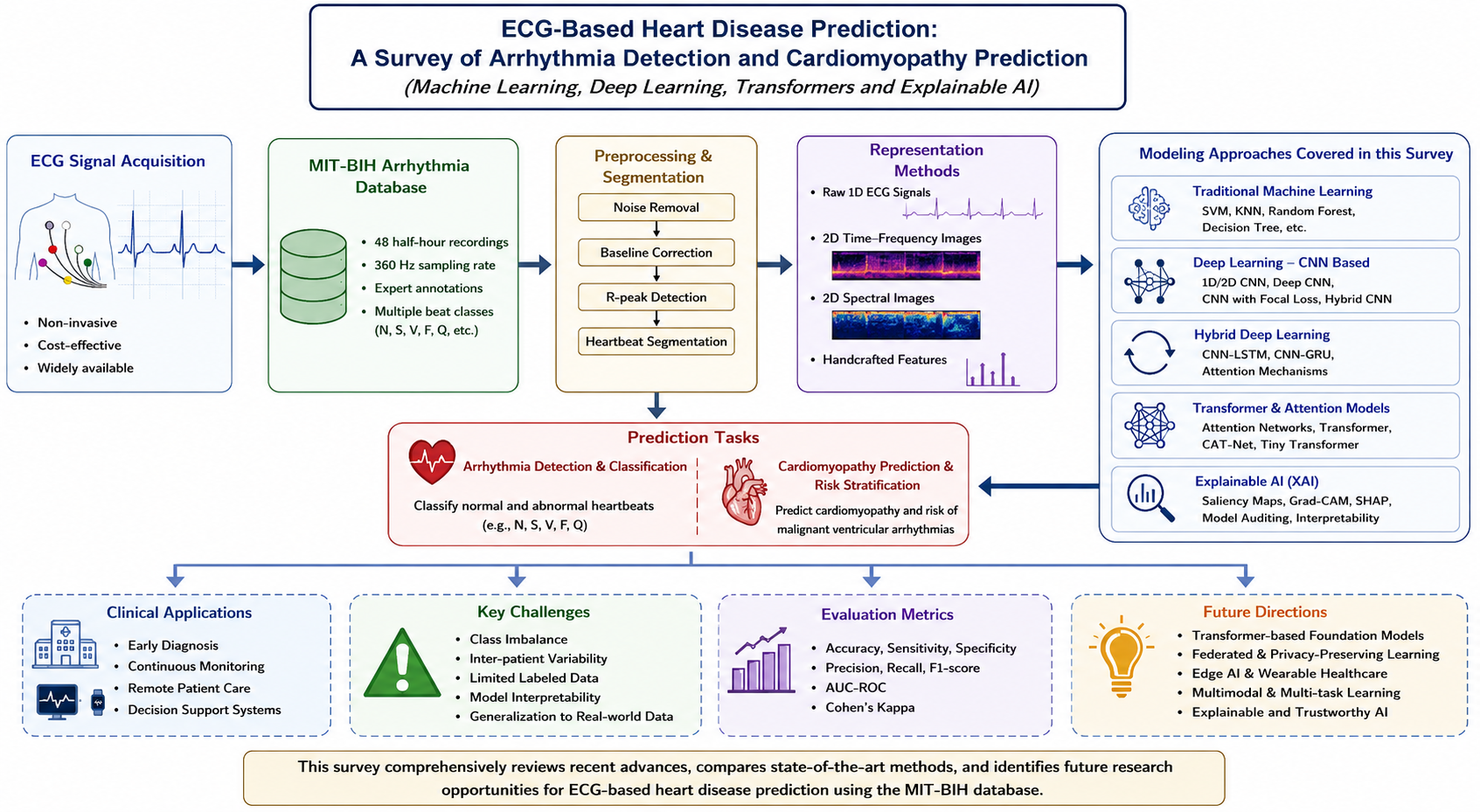
Cardiovascular diseases (CVDs) are still one of the main causes of death in the world and arrhythmia and cardiomyopathy are some of the most important types of cardiac diseases that need to be diagnosed early and treated correctly and promptly. Recently, electrocardiography (ECG) has become a basic non-invasive technique to study cardiac activity and diagnose cardiac rhythm and function disturbances. In the past few years, the accuracy and efficiency of automated ECG analysis have been enhanced by the development of Artificial Intelligence (AI), Machine Learning (ML), and Deep Learning (DL). This literature survey provides a thorough review of recent advancement in ECG-based heart disease prediction that involves arrhythmia detection and cardiomyopathy prediction with MIT-BIH Arrhythmia Database. The survey covers traditional machine learning techniques, convolutional neural networks (CNNs), hybrid deep learning networks, attention based models, transformer networks, and explainable Artificial Intelligence (XAI) techniques. Recent studies are analyzed using the comparative analysis method, which shows that deep learning models always outperform the traditional machine learning methods by learning the discriminative features from the raw ECG signals automatically. Moreover, novel transformer-based architectures and explainable deep learning approaches are shown to have great potential to enhance the diagnostic accuracy, explainability, and clinical use of deep learning. The survey also provides an overview of recent developments in the prediction and risk stratification of cardiomyopathy, using ECG. Lastly, current challenges and future research directions for next generation intelligent CVMSs such as federated learning, edge computing, wearable healthcare systems, and multimodal cardiac diagnostics are discussed to aid in the development of next generation intelligent CVMSs.
References
[1] Wu, M., Lu, Y., Yang, W. and Wong, S.Y.S. (2021) ‘A study on arrhythmia via ECG signal classification using the convolutional neural network’, Frontiers in Computational Neuroscience, 14, 564015. doi:10.3389/fncom.2020.564015.
[2] Ullah, A., Anwar, S.M., Bilal, M. and Mehmood, R.M. (2020) ‘Classification of arrhythmia by using deep learning with 2-D ECG spectral image representation’, arXiv. doi:10.48550/arXiv.2005.06902.
[3] Kachuee, M., Fazeli, S. and Sarrafzadeh, M. (2020) ‘Electrocardiogram heartbeat classification based on a deep convolutional neural network and focal loss’, Computers in Biology and Medicine, 123, 103866. doi:10.1016/j.compbiomed.2020.103866.
[4] Zhang, J., Xu, H., Wang, Z. and Zhao, Y. (2020) ‘A high-precision arrhythmia classification method based on dual fully connected neural network’, Biomedical Signal Processing and Control, 58, 101874. doi:10.1016/j.bspc.2020.101874.
[5] Rohmantri, R. and Surantha, N. (2020) ‘Arrhythmia classification using 2D convolutional neural network’, International Journal of Advanced Computer Science and Applications, 11(4), pp. 201–208. doi:10.14569/IJACSA.2020.0110427.
[6] Sharma, M., Sharma, R. and Poonia, R.C. (2020) ‘Patient specific machine learning models for ECG signal classification’, Procedia Computer Science, 167, pp. 2181–2190. doi:10.1016/j.procs.2020.03.269.
[7] Ansari, Y., Mourad, O., Qaraqe, K. and Serpedin, E. (2023) ‘Deep learning for ECG arrhythmia detection and classification: an overview of progress for period 2017–2023’, Frontiers in Physiology, 14. doi:10.3389/fphys.2023.1246746.
[8] Alinsaif, S. (2024) ‘Unraveling arrhythmias with graph-based analysis: A survey of the MIT-BIH database’, Computation, 12(2), 21. doi:10.3390/computation12020021.
[9] Zhou, C., Dai, P., Hou, A., Zhang, Z., Liu, L., Li, A. and Wang, F. (2024) ‘A comprehensive review of deep learning-based models for heart disease prediction’, Artificial Intelligence Review, 57, 263. doi:10.1007/s10462-024-10899-9.
[10] Wagner, P., Mehari, T., Haverkamp, W. and Strodthoff, N. (2024) ‘Explaining deep learning for ECG analysis: Building blocks for auditing and knowledge discovery’, Computers in Biology and Medicine, 176, 108525. doi:10.1016/j.compbiomed.2024.108525.
[11] van de Leur, R.R., de Brouwer, R., Bleijendaal, H., Verstraelen, T.E., Mahmoud, B., Perez-Matos, A., Dickhoff, C., Schoonderwoerd, B.A., Germans, T., Houweling, A., van der Zwaag, P.A., Cox, M.G.P.J., van Tintelen, J.P., te Riele, A.S.J.M., van den Berg, M.P., Wilde, A.A.M., Doevendans, P.A., de Boer, R.A. and van Es, R. (2024) ‘ECG-only explainable deep learning algorithm predicts the risk for malignant ventricular arrhythmia in phospholamban cardiomyopathy’, Heart Rhythm.
[12] Dias, F.M., Monteiro, H.L.M., Cabral, T.W., Naji, R., Kuehni, M. and Luz, E.J.S. (2021) ‘Arrhythmia classification from single-lead ECG signals using the inter-patient paradigm’, Computer Methods and Programs in Biomedicine, 202, 105948. doi:10.1016/j.cmpb.2021.105948.
[13] Hammad, M., Maher, A., Wang, K., Jiang, F. and Amrani, M. (2021) ‘A Hybrid Deep CNN Model for Abnormal Arrhythmia Detection Based on Cardiac ECG Signal’, Sensors, 21(3), 951. doi:10.3390/s21030951.
[14] Lampert, J., Vaid, A., Whang, W., Koruth, J., Miller, M.A., Langan, M.N., Musikantow, D., Turagam, M., Maan, A., Kawamura, I., Dukkipati, S., Nadkarni, G.N. and Reddy, V.Y. (2023) ‘A Novel ECG-Based Deep Learning Algorithm to Predict Cardiomyopathy in Patients With Premature Ventricular Complexes’, JACC: Clinical Electrophysiology, 9(8 Pt 2), pp. 1437–1451. doi:10.1016/j.jacep.2023.05.025.
[15] van de Leur, R.R., de Brouwer, R., Bleijendaal, H., Verstraelen, T.E., Mahmoud, B., Perez-Matos, A., Dickhoff, C., Schoonderwoerd, B.A., Germans, T., Houweling, A., van der Zwaag, P.A., Cox, M.G.P.J., van Tintelen, J.P., te Riele, A.S.J.M., van den Berg, M.P., Wilde, A.A.M., Doevendans, P.A., de Boer, R.A. and van Es, R. (2024) ‘ECG-only explainable deep learning algorithm predicts the risk for malignant ventricular arrhythmia in phospholamban cardiomyopathy’, Heart Rhythm, 21(7), pp. 1102–1112. doi:10.1016/j.hrthm.2024.02.038.
[16] Li, Y., Zhang, X., Wang, H. and Liu, J. (2024) ‘CAT-Net: Convolution, Attention and Transformer Based Network for Single-Lead ECG Arrhythmia Classification’, Biomedical Signal Processing and Control, 92, 106211. doi:10.1016/j.bspc.2024.106211.
[17] Wagner, P., Mehari, T., Haverkamp, W. and Strodthoff, N. (2024) ‘Explaining deep learning for ECG analysis: Building blocks for auditing and knowledge discovery’, Computers in Biology and Medicine, 176, 108525. doi:10.1016/j.compbiomed.2024.108525.
[18] Busia, P., Scrugli, M.A., Jung, V.J.B., Benini, L. and Meloni, P. (2024) ‘A Tiny Transformer for Low-Power Arrhythmia Classification on Microcontrollers’, arXiv Preprint, arXiv:2402.10748. doi:10.48550/arXiv.2402.10748.
Downloads
Published
Data Availability Statement
Data availability is not applicable to this paper as no new data were created or analyzed in this study.
Issue
Section
License
Copyright (c) 2026 International Journal of Computational Intelligence in Engineering (IJCIE)

This work is licensed under a Creative Commons Attribution-ShareAlike 4.0 International License.