Energy Conservation Strategies in Wireless Sensor Networks: Surveying Routing, Clustering, and Cross-Layer Optimization Approaches
DOI:
https://doi.org/10.5281/zenodo.20541652Keywords:
Wireless Sensor Networks, Clustering Algorithms, Energy Efficiency, Cross-Layer Optimization, Energy-Aware RoutingAbstract
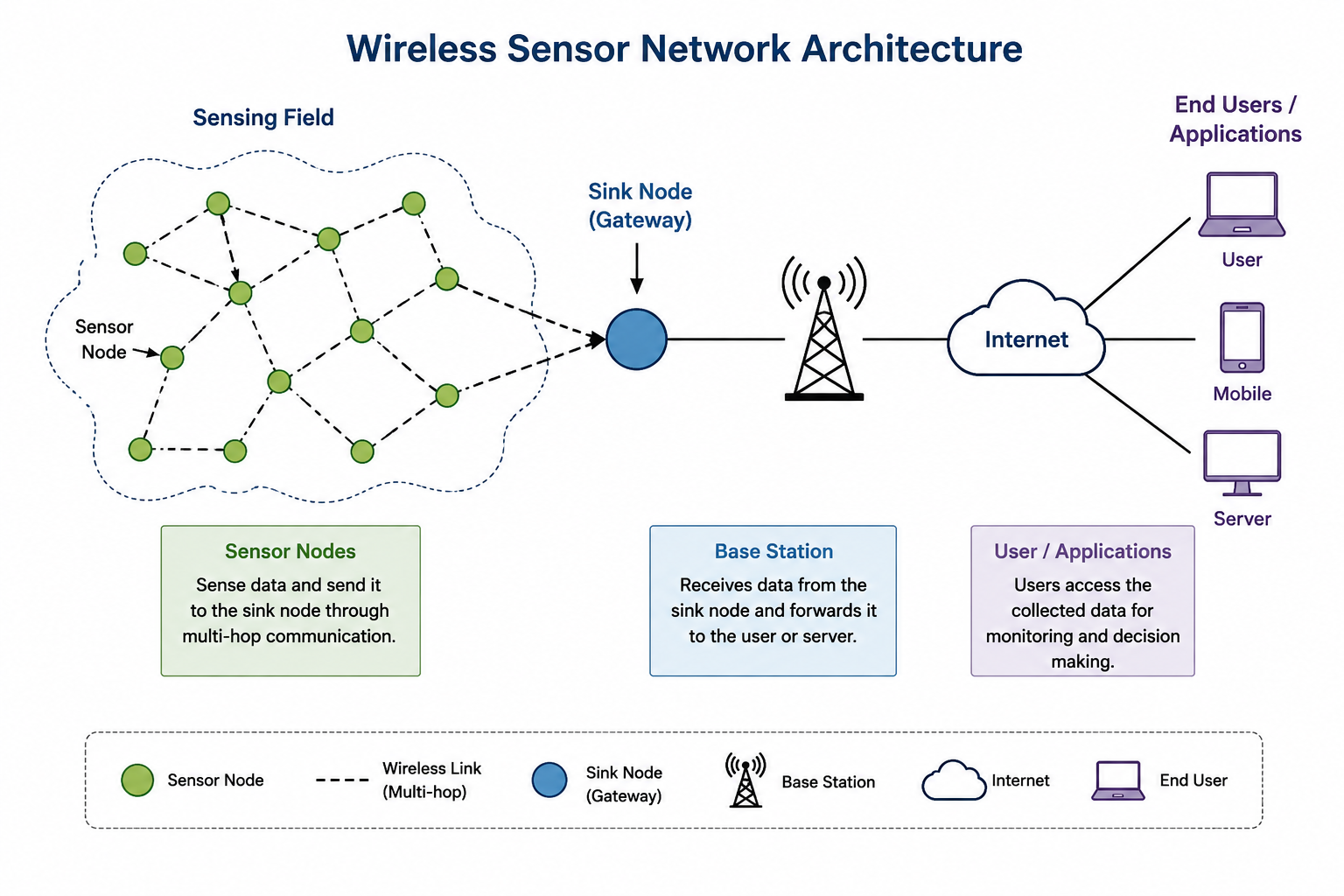
Wireless Sensor Networks (WSNs) are a key part of the modern Internet of Things (IoT), facilitating real time sensing, monitoring, and data transfer in a variety of applications including environmental monitoring, healthcare, industrial automation, smart agriculture and smart cities. The battery capacity constraints of sensor nodes, however, are a major limitation and energy efficiency is an important factor in the design of sensor networks to ensure their operation and reliability over extended periods. A large number of solutions have been proposed to improve the energy consumption and the network lifetime over the years, such as energy-aware routing protocols, clustering, sleep scheduling, data aggregation, and transmission power optimization. Recent developments have also brought in the concept of intelligent solutions such as artificial intelligence, machine learning, game theory, and optimization algorithms to enhance routing decisions and resource utilization. Furthermore, energy harvesting approaches and self-powered sensor networks are becoming attractive approaches for sustainable and long-term deployment. This survey aims to provide an in-depth overview of the recent advances of energy-efficient wireless sensor networks (WSN) during the years 2020-2026. The study includes routing protocols, clustering and deployment strategies, techniques of optimization, energy harvesting techniques, solutions based on artificial intelligence and cross-layer optimization techniques. Additionally, a comparative study of the current methods is given, so as to show their advantages, disadvantages and suitability of their use. The survey highlights the challenges in the current research and talks about the future directions in the development of intelligent, sustainable and energy aware wireless sensor network architectures.
References
[1] G. Samara, G. A. Besani, M. Alauthman, and M. A. Khaldy, “Energy-efficiency routing algorithms in wireless sensor networks: A survey,” arXiv preprint arXiv:2002.07178, 2020.
[2] A. Masood, “Survey on energy-efficient techniques for wireless sensor networks,” arXiv preprint arXiv:2105.10413, 2021.
[3] G. Shyamala, G. B. Pallavi, N. R. Latha, and I. S. Rajesh, “Coalition based game-theoretic routing technique for delay tolerant networks with cost and congestion optimization,” International Journal of Computational Intelligence in Engineering (IJCIE), vol. 1, no. 1, pp. 16–28, 2026, doi: 10.5281/zenodo.19513313.
[4] P. Ramaiah, R. Narmadha, and S. S. Pa, “Energy-efficient control methods in heterogeneous wireless sensor networks: A survey,” Engineering Proceedings, vol. 37, no. 1, p. 81, 2023, doi: 10.3390/ECP2023-14696.
[5] P. Bekal, P. Kumar, P. R. Mane, and G. Prabhu, “A comprehensive review of energy efficient routing protocols for query driven wireless sensor networks,” F1000Research, vol. 12, p. 644, 2024, doi: 10.12688/f1000research.133874.3.
[6] E. J. Machiwa, V. G. Masanja, M. F. Kisangiri, and J. W. Matiko, “A comprehensive survey on linear programming and energy optimization methods for maximizing lifetime of wireless sensor network,” Discover Computing, vol. 27, no. 1, p. 21, 2024, doi: 10.1007/s10791-024-09454-5.
[7] J. Murali and T. Shankar, “A survey on localization and energy efficiency in UWSN: Bio-inspired approach,” Discover Applied Sciences, vol. 6, no. 12, p. 633, 2024, doi: 10.1007/s42452-024-06318-x.
[8] H. Hu, X. Fan, and C. Wang, “Energy efficient clustering and routing protocol based on quantum particle swarm optimization and fuzzy logic for wireless sensor networks,” Scientific Reports, vol. 14, no. 1, p. 18595, 2024, doi: 10.1038/s41598-024-69360-0.
[9] P. Anusuya, C. Vanitha, J. Cho, and S. V. Easwaramoorthy, “A comprehensive review of sensor node deployment strategies for maximized coverage and energy efficiency in wireless sensor networks,” PeerJ Computer Science, vol. 10, p. e2407, 2024, doi: 10.7717/peerj-cs.2407.
[10] P. Chaurasia, A. Sharma, R. Gupta, and M. Verma, “Smart routing in DTNs: Integrating game theory with capacity, cost, and congestion models,” International Journal of Communication Networks and Information Security (IJCNIS), vol. 14, no. 2, pp. 702–715, 2022, doi: 10.5281/zenodo.15308829.
[11] A. Rana, K. Kaur, P. Kaur, and E. Bhatti, “Energy-efficient protocols for environmental monitoring in wireless sensor networks: A review,” Journal of Ambient Intelligence and Smart Environments, vol. 17, no. 2, pp. 139–163, 2025, doi: 10.1177/18761364241297221.
[12] M. U. Mushtaq, H. Venter, A. Singh, and M. Owais, “Advances in energy harvesting for sustainable wireless sensor networks: Challenges and opportunities,” Hardware, vol. 3, no. 1, 2025, doi: 10.3390/hardware3010001.
[13] S. Thakur, N. I. Sarkar, and S. Yongchareon, “AI-driven energy-efficient routing in IoT-based wireless sensor networks: A comprehensive review,” Sensors, vol. 25, no. 24, p. 7408, 2025, doi: 10.3390/s25247408.
[14] K. Zhang, S. Liu, S. An, Y. Zhou, and X. Pu, “Towards high-efficiency self-powered wireless sensor networks: A systematic review of co-design of energy and signal,” Nano Energy, p. 111337, 2025, doi: 10.1016/j.nanoen.2025.111337.
[15] H. Tian, “Enhancing the effectiveness of wireless sensor networks through consensus estimation and universal coverage,” Scientific Reports, vol. 15, no. 1, p. 24930, 2025, doi: 10.1038/s41598-025-10813-5.
[16] S. P. Pawale and P. G. Patil, “A comprehensive analysis of multi-channel MAC and clustering protocols for robust and energy-efficient wireless sensor networks,” Informatics and Automation, vol. 24, no. 3, pp. 828–855, 2025, doi: 10.15622/ia.24.3.4.
[17] K. R. Radhika, H. Nagesh Shenoy, T. R. Vinay, H. Pooja, D. Sharma, R. Priyanka, and S. Gupta, “Communication-efficient federated learning (CEFL) for CT image classification in bandwidth-constrained wireless healthcare networks,” International Journal of Drug Delivery Technology, vol. 16, no. 13S, 2026, doi: 10.25258/ijddt.16.13s.17.
[18] L. E. Alatabani, R. A. Saeed, and E. S. Ali, “Cross-layer optimization employing energy efficient routing protocols in WSN,” in Energy Efficient Internet of Things-Based Wireless Sensor Network. Hoboken, NJ, USA: Wiley, 2026, pp. 273–318, doi: 10.1002/9781394314751.ch10.
Downloads
Published
Data Availability Statement
Data availability is not applicable to this paper as no new data were created or analyzed in this study
Issue
Section
License
Copyright (c) 2026 International Journal of Computational Intelligence in Engineering (IJCIE)

This work is licensed under a Creative Commons Attribution-ShareAlike 4.0 International License.