A Novel Virtual Machine Migration Model for Optimizing Cloud Resource Utilization
DOI:
https://doi.org/10.5281/zenodo.20395041Keywords:
Load Balancing, Cloud Computing, Energy-Efficient Computing, Virtual Machine Migration, Resource Utilization, SLA-Aware OptimizationAbstract
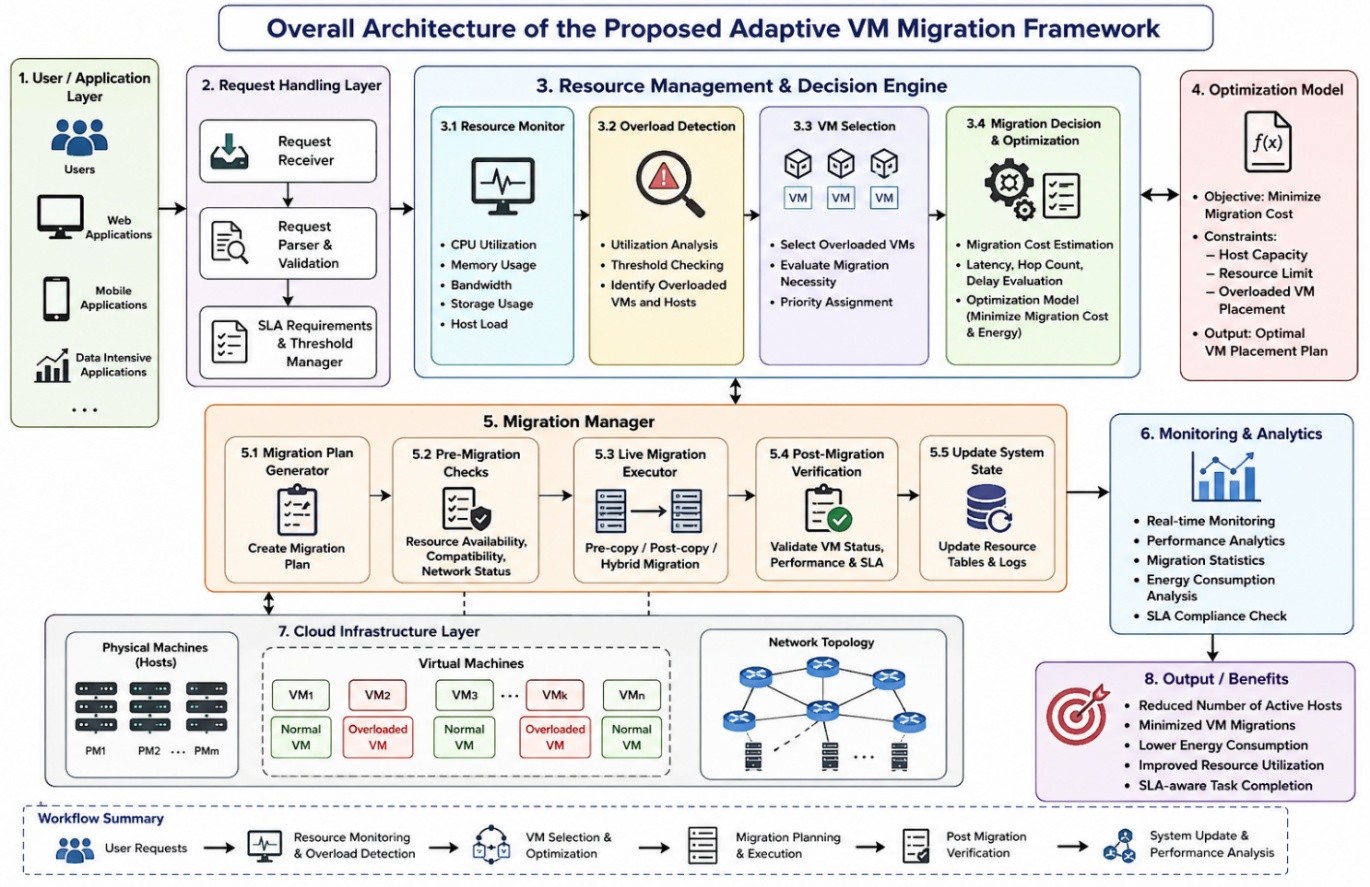
Cloud Computing has emerged as an important paradigm for delivery of scalable computing and storage resources using virtualization techniques. As cloud workloads grow rapidly, however, virtual machine (VM) overloading, energy usage, SLA violations and low system performance are common results. To address these issues, this work proposes an adaptive VM migration design for efficient resource utilization and VM load-balancing in a cloud environment. First, the proposed approach proposes to allocate VMs based on resources, taking into account the availability of processor resources, memory, and network conditions. A threshold-based migration strategy is then used to identify the overloaded VMs and migrate them automatically to appropriate physical machines which have lesser usage. Furthermore, to reduce the migration overhead and enhance the computation efficiency, the cost estimation based on latency, communication delay and hop distance are introduced for migration. An optimization model is also formulated to optimize the use of the energy and minimize the migration cost. Up to 200 virtual machines, with various host utilization thresholds and 40 simulation runs, are used in experimental analysis. Results show that the proposed method is able to decrease the number of active hosts, energy consumption and the frequency of VM migration when compared to other approaches like FFO-EVM and ACO. From the results obtained, it is concluded that the proposed adaptive migration framework is effective in enhancing the performance of the cloud, utilization of resources and efficiency of task completion with low computational overhead.
References
[1] K. Rajammal and M. Chinnadurai, “Dynamic load balancing in cloud computing using predictive graph networks and adaptive neural scheduling,” Scientific Reports, vol. 15, no. 1, pp. 1–18, 2025, doi: 10.1038/s41598-025-97494-2.
[2] D. Bodra and S. Khairnar, “Machine learning-based cloud resource allocation algorithms: A comprehensive comparative review,” Frontiers in Computer Science, vol. 7, pp. 1–22, 2025, doi: 10.3389/fcomp.2025.1678976.
[3] A. Kushchazli, K. Leonteva, I. Kochetkova, and A. Khakimov, “Evaluating QoS in dynamic virtual machine migration: A multi-class queuing model for edge-cloud systems,” Journal of Sensor and Actuator Networks, vol. 14, no. 3, pp. 47–61, 2025, doi: 10.3390/jsan14030047.
[4] K. Kotteswari, R. K. Dhanaraj, B. Balusamy, A. Nayyar, and A. K. Sharma, “EELB: An energy-efficient load balancing model for cloud environment using Markov decision process,” Computing, vol. 107, no. 81, pp. 1–20, 2025, doi: 10.1007/s00607-025-01439-6.
[5] Z. Jianping, “Optimal resource allocation and load balancing in SDN-based cloud computing: A comprehensive review and heuristic optimization approach,” SSRN Electronic Journal, pp. 1–8, 2025, doi: 10.2139/ssrn.5336093.
[6] A. I. Maiyza, H. A. Hassan, W. M. Sheta, K. Banawan, and N. O. Korany, “VTGAN based proactive VM consolidation in cloud data centers using value and trend approaches,” Scientific Reports, vol. 15, no. 1, pp. 20133–20148, 2025, doi: 10.1038/s41598-025-04757-z.
[7] S. Sakib, A. Katangur, and R. Dubey, “A dynamic approach to load balancing in cloud infrastructure: Enhancing energy efficiency and resource utilization,” arXiv preprint arXiv:2508.05821, pp. 1–12, 2025, doi: 10.48550/arXiv.2508.05821.
[8] C. Liu, L. Ma, M. Zhang, and H. Long, “Optimizing cloud resource management with an IoT-enabled optimized virtual machine migration scheme for improved efficiency,” Journal of Network and Computer Applications, vol. 237, p. 104137, 2025, doi: 10.1016/j.jnca.2025.104137.
[9] G. Sripathi and D. A. Khan, “Proactive resource allocation framework with SVM regression for cloud environments,” SN Computer Science, vol. 7, no. 1, p. 90, 2026, doi: 10.1007/s42979-025-04541-w.
[10] N. K. Sharma, S. Bojjagani, R. Uyyala, A. K. Maurya, and S. Kumari, “Deep learning BiLSTM and Branch-and-Bound based multi-objective virtual machine allocation and migration with profit, energy, and SLA constraints,” Sustainable Computing: Informatics and Systems, vol. 46, p. 101128, 2025, doi: 10.1016/j.suscom.2025.101128.
[11] Y. Y. Raghav and V. Vyas, “Cloud load balancing: Performance comparison between Bird Swarm and Ant Colony Optimization algorithms,” SN Computer Science, vol. 7, no. 1, p. 107, 2026, doi: 10.1007/s42979-025-04712-9.
[12] S. H. H. Madni, M. S. A. Latiff, and Y. Coulibaly, “Resource scheduling for infrastructure as a service (IaaS) in cloud computing: Challenges and opportunities,” Journal of Network and Computer Applications, vol. 68, pp. 173–200, 2016, doi: 10.1016/j.jnca.2016.04.016.
[13] M. Xu, W. Tian, and R. Buyya, “A survey on load balancing algorithms for virtual machines placement in cloud computing,” Concurrency and Computation: Practice and Experience, vol. 29, no. 12, pp. 1–24, 2017.
[14] N. Doumbouya, M. Hifi, and T. Saadi, “Parallel multi-objective optimization for predictive virtual machine placement and scheduling in cloud computing,” Future Generation Computer Systems, vol. 165, pp. 210–228, 2026.
[15] Y. Han et al., “Using virtual machine allocation policies to defend against co-resident attacks in cloud computing,” IEEE Transactions on Dependable and Secure Computing, vol. 14, no. 1, pp. 95–108, Jan.–Feb. 2017.
[16] S. Xu et al., “Energy-efficient dynamic consolidation of virtual machines in big data centers,” in Proc. Int. Conf. Green, Pervasive, and Cloud Computing, Cham, Switzerland: Springer, 2017, pp. 211–223.
[17] A. Khosravi, A. N. Toosi, and R. Buyya, “Online virtual machine migration for renewable energy usage maximization in geographically distributed cloud data centers,” Concurrency and Computation: Practice and Experience, vol. 29, no. 24, pp. 1–19, 2017.
[18] M. Duggan et al., “A network aware approach for the scheduling of virtual machine migration during peak loads,” Cluster Computing, vol. 20, no. 3, pp. 2089–2101, 2017.
[19] T.-Y. Wu, N. Guizani, and J.-S. Huang, “Live migration improvements by related dirty memory prediction in cloud computing,” Journal of Network and Computer Applications, vol. 90, pp. 83–89, 2017.
[20] S. Sohrabi et al., “Energy-efficient adaptive virtual machine migration mechanism for private clouds,” Concurrency and Computation: Practice and Experience, vol. 29, no. 18, pp. 1–17, 2017.
[21] F. Teng et al., “Energy efficiency of VM consolidation in IaaS clouds,” The Journal of Supercomputing, vol. 73, no. 2, pp. 782–809, 2017.
[22] E. Zola and A. J. Kassler, “Optimising for energy or robustness? Trade-offs for VM consolidation in virtualized datacenters under uncertainty,” Optimization Letters, vol. 11, no. 8, pp. 1571–1592, 2017.
[23] M. Abdullah et al., “A heuristic-based approach for dynamic VMs consolidation in cloud data centers,” Arabian Journal for Science and Engineering, vol. 42, no. 8, pp. 3525–3539, 2017.
[24] N. J. Kansal and I. Chana, “Energy-aware virtual machine migration for cloud computing—A firefly optimization approach,” Journal of Grid Computing, vol. 14, no. 2, pp. 327–345, 2016.
Downloads
Published
Data Availability Statement
Data can be provided on genuine request.
Issue
Section
License
Copyright (c) 2026 International Journal of Computational Intelligence in Engineering (IJCIE)

This work is licensed under a Creative Commons Attribution-ShareAlike 4.0 International License.