A Hybrid CEFL Approach Using Gradient Sparsification and Quantization for Medical Imaging
DOI:
https://doi.org/10.5281/zenodo.19328453Keywords:
Federated Learning, CT Classification, Wireless Edge Computing, Gradient Compression, Privacy-Preserving AI, MedTech, Deep Learning, LIDC-IDRIAbstract
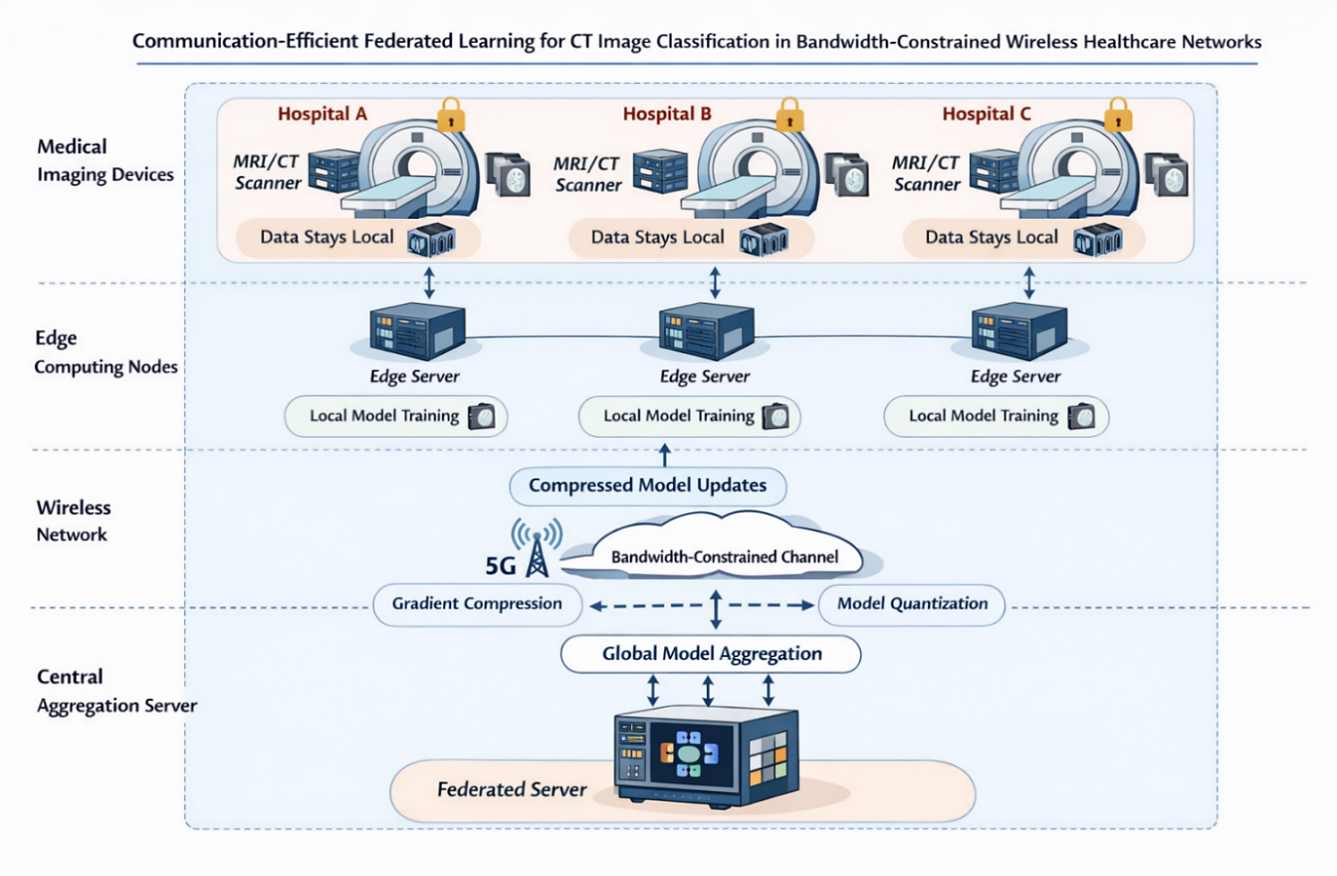
The use of deep learning in the classification of medical imaging Computed Tomography (CT) images has greatly enhanced the accuracy of the diagnosis in the medical field. Nevertheless, conventional centralized solutions necessitate the transfer of big amounts of medical information to a central point of the server, which results in high bandwidth rates, high latency, and severe issues of privacy, especially in a wireless healthcare scenario. Federated Learning (FL) could be a good solution; it provides the possibility to conduct collaborative training of the model without providing the actual patient data. However, traditional FL approaches have a high communication cost, as they frequently exchange massive model updates, and cannot be used in networks with tight bandwidth constraints. To overcome these difficulties, this paper suggests a Communication-Efficient Federated Learning (CEFL) system to distributed CT image classification. The suggested method combines the gradient sparsification, model quantization, and adaptive scheduling of communications to achieve relatively small and less regular model updates. The framework is executed with the help of a multi-layer structure that includes a medical imaging, edge computing, wireless communication, and federated aggregation layers. LIDC-IDRI CT dataset is put to experiments with simulated bandwidth-constrained conditions. The findings show that the suggested CEFL model can cut down on overhead in communication by up to 40-60% with respect to the traditional FL approaches like FedAvg and that it can attain high-quality approaches of about 90% in classification. Moreover, the latency is considerably lowered, and therefore the system can be used in wireless healthcare in real-time. These results indicate the usefulness of communication-efficient designs in facilitating scalable privacy-preserving medical image analysis.
References
S. Nazir and M. Kaleem, “Federated learning for medical image analysis with deep neural networks,” Diagnostics, vol. 13, no. 9, pp. 1532-1550, 2023, doi: 10.3390/diagnostics13091532.
H. Guan, M. Liu, and Y. Wang, “Federated learning for medical image analysis: A survey,” Pattern Recognition, vol. 151, pp. 110424, 2024, doi: 10.1016/j.patcog.2024.110424.
E. Albalawi, M. Alshammari, and A. Alqahtani, “Federated learning-based brain tumor classification using deep learning,” BMC Medical Imaging, vol. 24, no. 1, pp. 1-15, 2024, doi: 10.1186/s12880-024-01261-0.
J. T. Teo, R. J. McKinney, and D. Atkinson, “Federated learning for medical imaging radiology,” British Journal of Radiology, vol. 96, no. 1146, pp. 20220890, 2023, doi: 10.1259/bjr.20220890.
M. A. Rashid, S. Khan, and I. Ullah, “Secure federated learning approach for CT image-based COVID-19 detection,” Traitement du Signal, vol. 41, no. 6, pp. 1205-1216, 2024, doi: 10.18280/ts.410605.
S. T. Ahmed, R. Hassan, and M. R. Islam, “Blockchain-based federated learning in AIoMT healthcare systems,” BMC Medical Imaging, vol. 24, no. 1, pp. 1-18, 2024, doi: 10.1186/s12880-024-01279-4.
F. Maqsood, A. Rehman, and M. A. Khan, “AI-based classification of CT images using hybrid deep learning models,” Cognitive Computation, vol. 16, no. 2, pp. 345-360, 2024, doi: 10.1007/s12559-023-10123-5.
M. Liu, H. Guan, and Y. Wang, “Federated learning for distributed medical imaging: Recent advances and challenges,” Pattern Recognition, vol. 151, pp. 110424, 2024, doi: 10.1016/j.patcog.2024.110424.
C. S. Lee, J. Park, and H. Kim, “Federated learning-based CT liver tumor detection in multi-institutional datasets,” BMC Medical Imaging, vol. 25, no. 1, pp. 1-14, 2025, doi: 10.1186/s12880-025-01045-2.
J. Zhou, X. Liu, and Y. Zhang, “Personalized and privacy-preserving federated medical image analysis,” arXiv preprint arXiv:2302.11571, pp. 1-12, 2023.
Y. Wu, Z. Chen, and L. Wang, “Federated adaptive CLIP model for medical image classification,” arXiv preprint arXiv:2410.14707, pp. 1-15, 2024.
A. Parida, S. Mishra, and R. Das, “Federated template and task learning for multi-institutional medical imaging,” arXiv preprint arXiv:2601.16302, pp. 1-18, 2026.
M. A. Khan et al., “Enhancing medical image classification via federated learning,” Egyptian Informatics Journal, vol. 27, p. 100530, 2024, doi: 10.1016/j.eij.2024.100530.
S. Kim et al., “Communication-efficient federated learning for multi-organ segmentation,” IEEE Trans. Med. Imaging, vol. 44, no. 5, pp. 2079-2090, 2025.
Z. Zhou et al., “Federated learning for medical image classification: A benchmark,” IEEE J. Biomed. Health Inform., 2025, doi: 10.1109/JBHI.2025.3631706.
Y. Ma, Z. Liu, and H. Wang, “One-shot federated learning for medical imaging,” arXiv preprint arXiv:2507.19045, pp. 1-12, 2025.
S. D. Nagaraju, R. K. Gupta, and P. Singh, “FedGIN: Federated learning for multimodal medical images,” arXiv preprint arXiv:2508.05137, pp. 1-15, 2025.
B. McMahan, E. Moore, D. Ramage, S. Hampson, and B. A. y Arcas, “Communication-efficient learning of deep networks from decentralized data,” in Proc. 20th Int. Conf. Artificial Intelligence and Statistics (AISTATS), vol. 54, pp. 1273-1282, 2017.
T. Li, A. Sahu, M. Zaheer, M. Sanjabi, A. Talwalkar, and V. Smith, “Federated optimization in heterogeneous networks (FedProx),” in Proc. Machine Learning and Systems (MLSys), vol. 2, pp. 429-450, 2020.
IS, Rajesh, Bharathi Malakreddy Arikerie, and Bharati M. Reshmi. "A review on automatic identification of fovea in retinal fundus images." International Journal of Medical Engineering and Informatics, vol. 12, no. 2, pp.169-179, 2020. DOI: 10.1504/IJMEI.2020.106900
Ranjitha, U.N., & Gowtham, M. A., “BCDU-Net and chronological-AVO based ensemble learning for lung nodule segmentation and classification,” Computer Methods in Biomechanics and Biomedical Engineering: Imaging & Visualization, vol. 11, no. 4, pp. 1491–1511, 2023.
Downloads
Published
Data Availability Statement
Data availability is not applicable to this paper as no new data were created or analyzed in this study.
Issue
Section
License
Copyright (c) 2026 International Journal of Computational Intelligence in Engineering (IJCIE)

This work is licensed under a Creative Commons Attribution-ShareAlike 4.0 International License.