Deep Learning-Based Lung Nodule Classification and Lung Cancer Diagnosis: A Comprehensive Literature Review
DOI:
https://doi.org/10.5281/zenodo.20428375Keywords:
Lung Cancer, Classification, Segmentation, Pulmonary Nodules, Literature ReviewAbstract
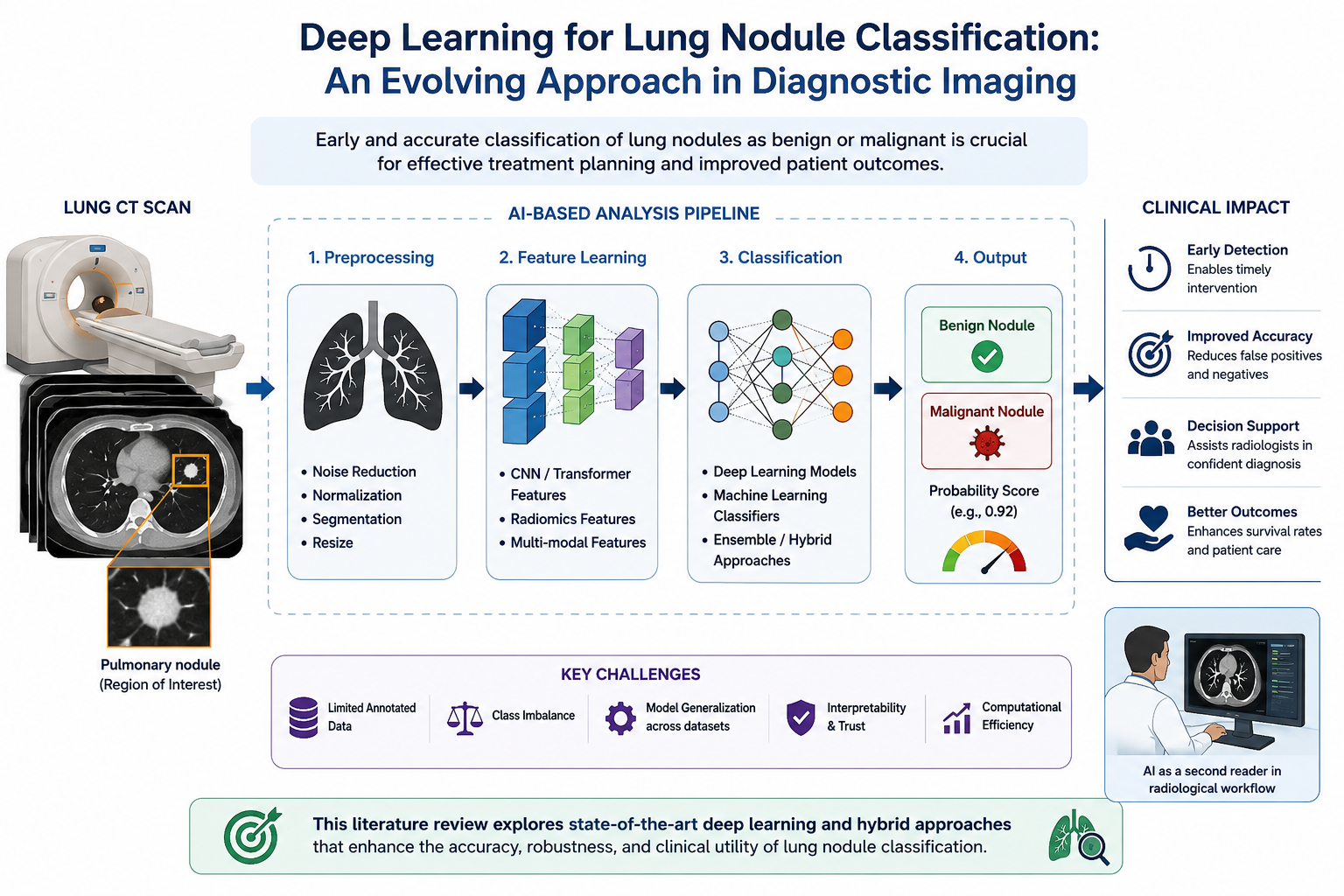
Lung cancer is still one of the major causes of cancer-related deaths in the world and timely and precise diagnosis is very important to enhance survival of the patients. The past decade has seen remarkable progress in the medical image analysis arena for detection, segmentation and classification of pulmonary nodules, which is driven by the recent developments in Artificial Intelligence (AI) and Deep Learning (DL). This literature review aims to provide a thorough overview of recent research articles published from 2025 to 2026 related to lung nodule classification based on computed tomography (CT) and chest radiography images within the context of deep learning. The review delves into the mechanisms of several architectures such as Convolutional Neural Networks (CNNs), Vision Transformers (ViTs), ensemble learning, transfer learning, multi-task learning, Neural Architecture Search (NAS), and Explainable AI (XAI). Furthermore, the segmentation methods and data augmentation strategies are explored, as well as being evaluated in conjunction with hybrid AI frameworks. The review points out the advantages, weaknesses, and the data sets, measures, and clinical utility of the available approaches. Results suggest that transformer-based models, hybrid CNN-transformer models, and explainable ensemble models outperform the classification accuracy of other models, which is above 95%, in several research studies. There are many challenges that are yet to be solved, including the limited annotated datasets, interpretability of the models, generalization across clinical environments and computational complexity. Multimodal learning, federated learning, integrating explainable AI, and clinically validated real-time diagnostics are directions for future research.
References
[1] Y. Huang, Q. Li, H. Chen, X. Zhou, Q. Han, H. Lu, and Q. Cao, “A novel approach to integrating Vision Transformers and machine learning for robust lung nodule classification using CT imaging,” Journal of Radiation Research and Applied Sciences, vol. 18, no. 3, p. 101672, 2025.
[2] M. K. Faizi, Y. Qiang, Y. Wei, Y. Qiao, J. Zhao, R. Aftab, and Z. Urrehman, “Deep learning-based lung cancer classification of CT images,” BMC Cancer, vol. 25, no. 1, p. 1056, 2025.
[3] J. Pan, L. Liang, P. Sun, Y. Liang, J. Zhu, and Z. Chen, “MSA-Net: Multiple self-attention mechanism for 3D lung nodule classification in CT images,” BMC Medical Imaging, vol. 25, no. 1, p. 193, 2025.
[4] N. R. Lavuri, J. S. Rao, B. Shankar, V. S. Kumar, and G. K. Reddy, “Deep learning method for lung cancer diagnosis and nodule classification using neural networks,” in Proc. 8th Int. Conf. Trends Electron. Informatics (ICOEI), 2025, pp. 1710–1714.
[5] M. A. Tawfeek, I. Alrashdi, M. Alruwaili, W. M. Shaban, and F. M. Talaat, “Enhancing the efficiency of lung cancer screening: Predictive models utilizing deep learning from CT scans,” Neural Computing and Applications, vol. 37, no. 17, pp. 11459–11477, 2025.
[6] R. Sudha and K. U. Maheswari, “Analysis on grading of lung nodule images with segmentation using U-Net and classification with convolutional neural network fish swarm optimization,” Biocybernetics and Biomedical Engineering, vol. 45, no. 1, pp. 90–104, 2025.
[7] M. Z. I. Noman, K. Sati, M. A. Yousuf, S. Aloteibi, and M. A. Moni, “LungCT-NET: An explainable transfer learning-based robust ensemble model for lung cancer diagnosis,” Knowledge-Based Systems, vol. 324, p. 113854, 2025.
[8] M. S. Rahman, M. E. Chowdhury, H. R. Rahman, M. U. Ahmed, M. A. Kabir, and R. Sarmun, “Self-DenseMobileNet: A robust framework for lung nodule classification using Self-ONN and stacking-based meta-classifier,” Biomedical Signal Processing and Control, vol. 112, p. 108588, 2026.
[9] C. Gao, L. Wu, W. Wu, Y. Huang, X. Wang, Z. Sun, and C. Gao, “Deep learning in pulmonary nodule detection and segmentation: A systematic review,” European Radiology, vol. 35, no. 1, pp. 255–266, 2025.
[10] P. Xue, H. Lu, Y. Fu, H. Ji, M. Ren, T. Xiao, and E. Dong, “Prior knowledge-based multi-task learning network for pulmonary nodule classification,” Computerized Medical Imaging and Graphics, vol. 121, p. 102511, 2025.
[11] A. G. Akintola, K. Y. Obiwusi, Y. O. Olatunde, M. Usman, F. G. Aberuagba, M. A. Adebisi, and S. A. Adebayo, “Integrated deep learning paradigm for comprehensive lung cancer segmentation and classification using Mask R-CNN and CNN models,” Franklin Open, vol. 11, p. 100278, 2025.
[12] C. Patel, Y. Wang, R. Tchoua, A. Orhean, J. Furst, and D. Raicu, “Enhancing lung nodule classification with variational autoencoder-based image augmentation,” in Medical Imaging 2025: Computer-Aided Diagnosis, vol. 13407, 2025, pp. 662–668.
[13] J. Yu, T. Li, X. Shi, Z. Zhao, M. Chen, Y. Zhang, and B. Hu, “ETMO-NAS: An efficient two-step multimodal one-shot NAS for lung nodules classification,” Biomedical Signal Processing and Control, vol. 104, p. 107479, 2025.
[14] S. Miao, Q. Dong, L. Liu, Q. Xuan, Y. An, H. Qi, and R. Wang, “Dual biomarkers CT-based deep learning model incorporating intrathoracic fat for discriminating benign and malignant pulmonary nodules in multi-center cohorts,” Physica Medica, vol. 129, p. 104877, 2025.
[15] R. Jia, B. Liu, and M. Ali, “Establishing an AI-based diagnostic framework for pulmonary nodules in computed tomography,” BMC Pulmonary Medicine, vol. 25, no. 1, p. 339, 2025.
[16] Communication-Efficient Federated Learning (CEFL) for CT Image Classification in Bandwidth-Constrained Wireless Healthcare Networks,” International Journal of Drug Delivery Technology, vol. 16, no. 13s, pp. 163–172, 2026, doi: 10.25258/ijddt.16.13s.17
Downloads
Published
Data Availability Statement
Data can be provided on genuine request
Issue
Section
License
Copyright (c) 2026 International Journal of Computational Intelligence in Engineering (IJCIE)

This work is licensed under a Creative Commons Attribution-ShareAlike 4.0 International License.