Intrusion Detection Systems Utilizing Deep Learning: A Comprehensive Literature Review
DOI:
https://doi.org/10.5281/10.5281/zenodo.20541381Keywords:
Intrusion Detection System, Cybersecurity, Network Security, Deep Learning, Anomaly DetectionAbstract
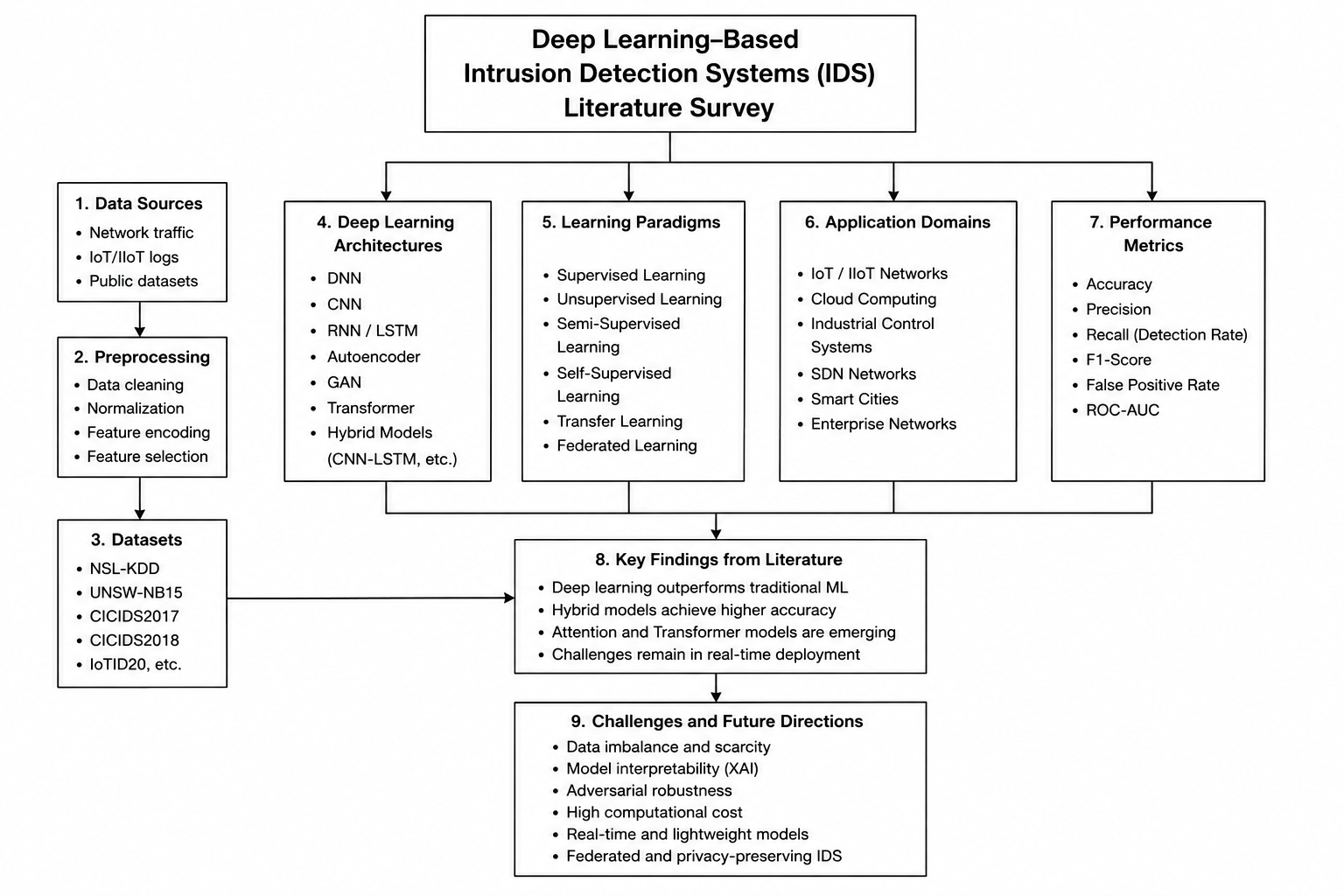
Certainly, with the increasing sophistication of cyberattacks, the need for intelligent Intrusion Detection Systems (IDSs) that can detect known and unknown threats in real time has become more critical than ever. Conventional IDSs (e.g., signature- and machine-learning based) are not effective against high-dimensional network traffic, zero-day attacks, and dynamic threat environments. With the ability to automatically capture complex features and learn hierarchical representations from a large volume of network data, Deep Learning (DL) has been a promising solution. In this review, the progress in deep learning IDS research from 2020 to 2026 is discussed. The study examines several architectures, such as Deep Neural Networks (DNNs), Convolutional Neural Networks (CNNs), Recurrent Neural Networks (RNNs), Long Short-Term Memory (LSTM) networks, Autoencoders (AEs), Generative Adversarial Networks (GANs), and Transformer-based models. In addition, the commonly used benchmark datasets, performance measures, challenges, and future research directions are discussed. The review shows that the hybrid deep learning architecture consistently outperforms the traditional methods in terms of performance, with an accuracy of high detection performance and low false alarm. There are, however, open research challenges like dataset imbalance, model explainability, adversarial robustness and computational complexity. This paper utilizes keywords such as Deep Learning, CNN, LSTM, Transformer, Intrusion Detection System, Cybersecurity, Network Security, Anomaly Detection.
References
[1] Alshehri, M.S., Saidani, O., Alrayes, F.S., Abbasi, S.F. and Ahmad, J. (2024) ‘A Self-Attention-Based Deep Convolutional Neural Networks for IIoT Networks Intrusion Detection’, IEEE Access, 12, pp. 45762–45772. Available at: https://doi.org/10.1109/ACCESS.2024.3380816.
[2] Anis, F.M., Alabdullatif, M., Aljbli, S. and Hammoudeh, M. (2025) ‘A Survey on the Applications of Deep Learning in Network Intrusion Detection Systems to Enhance Network Security’, IEEE Access, 13, pp. 185357–185373. Available at: https://doi.org/10.1109/ACCESS.2025.3624952.
[3] Chatterjee, S., Chaudhary, S. and Cherukuri, A.K. (2025) ‘Intrusion Detection System Using Deep Learning for Network Security’, arXiv preprint arXiv:2505.05810. Available at: https://arxiv.org/abs/2505.05810.
[4] Chinnasamy, R., Subramanian, M., Easwaramoorthy, S.V. and Cho, J. (2025) ‘Deep learning-driven methods for network-based intrusion detection systems: A systematic review’, ICT Express, 11(1), pp. 181–215. Available at: https://doi.org/10.1016/j.icte.2025.01.005.
[5] Ferrag, M.A., Maglaras, L., Moschoyiannis, S. and Janicke, H. (2022) ‘Deep learning for cyber security intrusion detection: Approaches, datasets and comparative analysis’, Future Generation Computer Systems, 128, pp. 168–187.
[6] Hozouri, A., Mirzaei, A. and Effatparvar, M. (2025) ‘A comprehensive survey on intrusion detection systems with advances in machine learning, deep learning and emerging cybersecurity challenges’, Discover Artificial Intelligence, 5, Article 314. Available at: https://doi.org/10.1007/s44163-025-00578-1.
[7] Hu, X., Meng, X., Liu, S. and Liang, L. (2024) ‘An Improved Algorithm for Network Intrusion Detection Based on Deep Residual Networks’, IEEE Access, 12, pp. 66432–66441. Available at: https://doi.org/10.1109/ACCESS.2024.3398007.
[8] Husák, M., Manoj, D. and Kumar, P. (2024) ‘Machine Learning in Intrusion Detection: An Operational Perspective’, in Proceedings of the 20th International Conference on Network and Service Management (CNSM 2024). IEEE, pp. 1–7. Available at: https://doi.org/10.23919/CNSM62983.2024.10814637.
[9] Kimanzi, R., Kimanga, P., Cherori, D. and Gikunda, P.K. (2024) ‘Deep Learning Algorithms Used in Intrusion Detection Systems – A Review’, arXiv preprint arXiv:2402.17020. Available at: https://arxiv.org/abs/2402.17020.
[10] Lansky, J., Ali, S., Rahmani, A.M. and Hosseinzadeh, M. (2021) ‘Deep Learning-Based Intrusion Detection Systems: A Systematic Review’, IEEE Access, 9, pp. 101574–101599.
[11] Mohale, V.Z. and Obagbuwa, I.C. (2025) ‘A systematic review on the integration of explainable artificial intelligence in intrusion detection systems to enhancing transparency and interpretability in cybersecurity’, Frontiers in Artificial Intelligence, 8, Article 1526221. Available at: https://doi.org/10.3389/frai.2025.1526221.
[12] Nakip, M. and Gelenbe, E. (2024) ‘Online Self-Supervised Deep Learning for Intrusion Detection Systems’, IEEE Transactions on Information Forensics and Security, 19, pp. 5668–5681.
[13] Nasereddin, M., Nakip, M. and Gelenbe, E. (2024) ‘Deep Learning Intrusion Detection and Mitigation of DoS Attacks’, in Proceedings of the 32nd International Symposium on Modeling, Analysis and Simulation of Computer and Telecommunication Systems (MASCOTS 2024). IEEE. Available at: https://doi.org/10.1109/MASCOTS64422.2024.10786560.
[14] Pinto Neto, E.C., Iqbal, S., Buffett, S., Sultana, M. and Taylor, A. (2025) ‘Deep learning for intrusion detection in emerging technologies: A comprehensive survey and new perspectives’, Artificial Intelligence Review, 58, Article 340. Available at: https://doi.org/10.1007/s10462-025-11346-z.
[15] Rehman, H.M.R., Liaquat, S., Gul, M.J., Jhandir, M.Z. and Gavilanes, D. (2025) ‘A systematic literature study of machine learning techniques based intrusion detection: datasets, models, challenges, and future directions’, Journal of Big Data, 12, Article 264. Available at: https://doi.org/10.1186/s40537-025-01323-2.
[16] Shivhare, I., Purohit, J., Jogani, V., Attari, S. and Chandane, M. (2023) ‘Intrusion Detection: A Deep Learning Approach’, arXiv preprint arXiv:2306.07601. Available at: https://arxiv.org/abs/2306.07601.
[17] Xu, Z., Wu, Y., Wang, S., Gao, J., Qiu, T., Wang, Z., Wan, H. and Zhao, X. (2025) ‘Deep Learning-based Intrusion Detection Systems: A Survey’, arXiv preprint arXiv:2504.07839. Available at: https://arxiv.org/abs/2504.07839.
[18] Zhang, Y., Liu, H., Wang, Q. and Chen, X. (2025) ‘A Review of Deep Learning Applications in Intrusion Detection Systems: Overcoming Challenges in Spatiotemporal Feature Extraction and Data Imbalance’, Applied Sciences, 15(3), Article 1552. Available at: https://doi.org/10.3390/app15031552.
[19] Fares, I.A., Ibrahim, A.G.A., Elaziz, M.A., Shrahili, M., Elmahallawy, A.A., Sohaib, R.M., Shawky, M.A. and Shah, A.S.T. (2025) ‘Deep transfer learning based on hybrid Swin transformers with LSTM for intrusion detection systems in IoT environment’, IEEE Open Journal of the Communications Society, 6, pp. 4342–4365. Available at: https://doi.org/10.1109/OJCOMS.2025.3569301.
[20] A comparative deep-learning study using DNN, CNN, RNN, LSTM, GRU and CNN-LSTM architectures for network intrusion detection was published in IEEE Access in 2024 and can also be cited if you need more than 20 references.
Downloads
Published
Data Availability Statement
Data availability is not applicable to this paper as no new data were created or analyzed in this study.
Issue
Section
License
Copyright (c) 2026 International Journal of Computational Intelligence in Engineering (IJCIE)

This work is licensed under a Creative Commons Attribution-ShareAlike 4.0 International License.