Deep Feature Fusion and Ensemble Voting Based Brain Tumor Classification Framework
DOI:
https://doi.org/10.5281/zenodo.20412176Keywords:
Brain Tumor, Computer Vision, Image Classification, Deep learning, Biomedical ApplicationAbstract
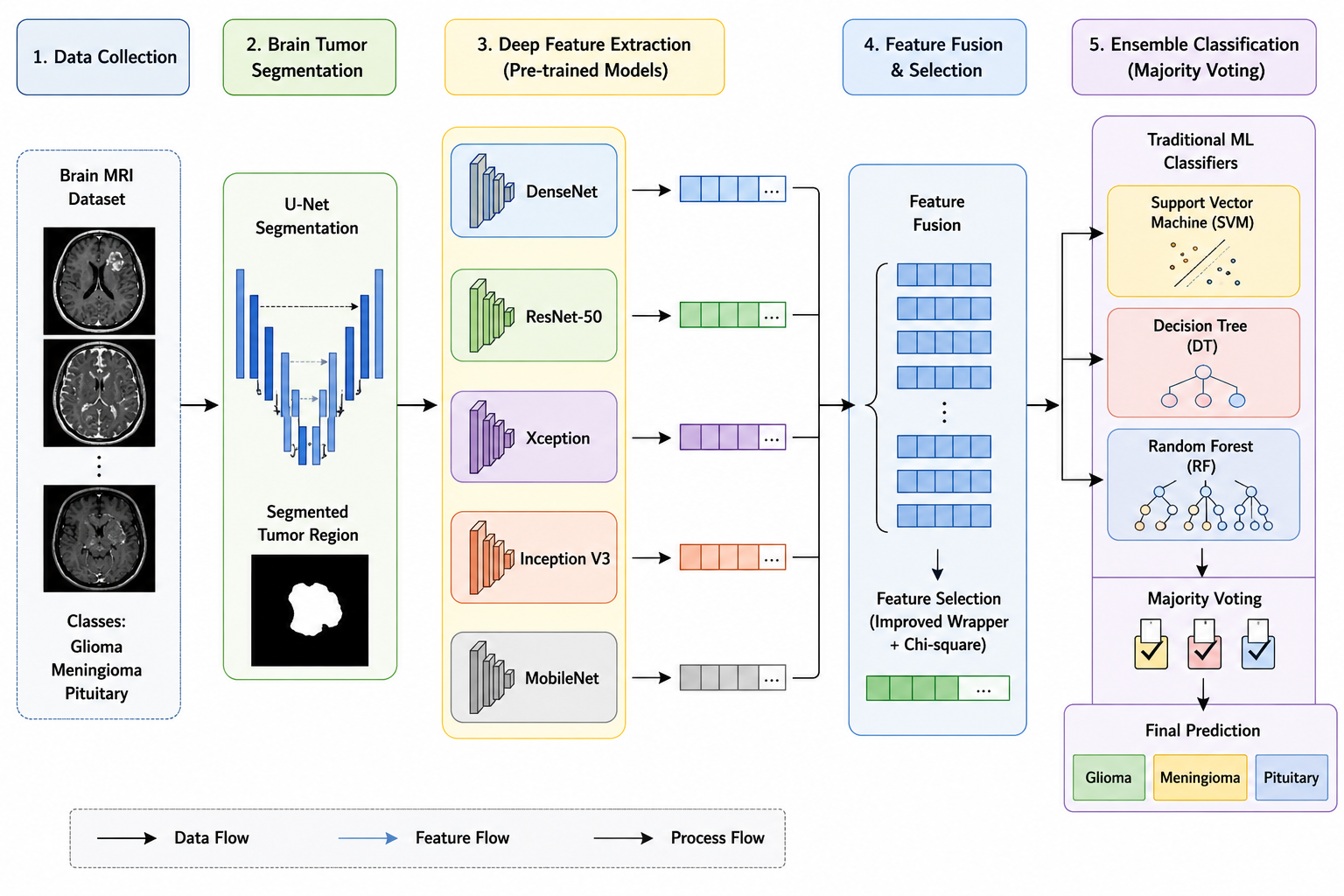
The classification of brain tumors is important in the diagnosis and treatment planning and patient management. With the increasing need for automated Computer-Aided Diagnosis (CAD) systems, Deep Learning (DL) techniques for biomedical image analysis have gained a more significant pace. In this study, a hybrid deep learning framework is proposed which combines the three most prominent architectures: DenseNet, ResNet, and Xception to classify brain tumors. The advantages of each model are different: Reusing features, residual learning with skip connections and computational efficiency with depth-wise separable convolutions. The proposed ensemble architecture combines the advantages of these architectures and enhances the classification accuracy and robustness. An improved feature selection mechanism is used to refine the deep features extracted from the models and an ensemble deep learning model with maximum voting method is used for final prediction. It is shown that the proposed framework can be effective in accurate and reliable classification of brain tumor through experimental analysis. The results of the experimental analysis show that the proposed framework resulted with an overall classification accuracy of 99.85%, accuracy of 99% and recall of 98%, which is very successful in the brain tumor classification task and can be used to classify the brain tumors accurately and reliably.
References
[1] Akram, F., Liu, D., Zhao, P., Kryvinska, N., Abbas, S., & Rizwan, M. (2021). Trustworthy intrusion detection in e-healthcare systems. Frontiers in public health, 9, 788347.
[2] Sharif, M. I., Li, J. P., Naz, J., & Rashid, I. (2020). A comprehensive review on multi-organs tumor detection based on machine learning. Pattern Recognition Letters, 131, 30-37.
[3] Can (2022). Cancer. Available online at: https://www.who.int/news-room/fact-sheets/detail/cancer
[4] Xie, Y., Zaccagna, F., Rundo, L., Testa, C., Agati, R., Lodi, R., ... & Tonon, C. (2022). Convolutional neural network techniques for brain tumor classification (from 2015 to 2022): Review, challenges, and future perspectives. Diagnostics, 12(8), 1850.
[5] Mandle, A. K., Sahu, S. P., & Gupta, G. (2022). Brain tumor segmentation and classification in MRI using clustering and kernel-based SVM. Biomedical and Pharmacology Journal, 15(2), 699-716.
[6] Chugh, G., Kumar, S., & Singh, N. (2021). Survey on machine learning and deep learning applications in breast cancer diagnosis. Cognitive Computation, 1-20.
[7] Bechelli, S., & Delhommelle, J. (2022). Machine learning and deep learning algorithms for skin cancer classification from dermoscopic images. Bioengineering, 9(3), 97.
[8] Latif, J., Xiao, C., Imran, A., & Tu, S. (2019, January). Medical imaging using machine learning and deep learning algorithms: a review. In 2019 2nd International conference on computing, mathematics and engineering technologies (iCoMET) (pp. 1-5). IEEE.
[9] Nasir, M., Attique Khan, M., Sharif, M., Lali, I. U., Saba, T., & Iqbal, T. (2018). An improved strategy for skin lesion detection and classification using uniform segmentation and feature selection based approach. Microscopy research and technique, 81(6), 528-543.
[10] Sharif, M., Tanvir, U., Munir, E. U., Khan, M. A., & Yasmin, M. (2018). Brain tumor segmentation and classification by improved binomial thresholding and multi-features selection. Journal of ambient intelligence and humanized computing, 1-20.
[11] Başaran, E. (2022). A new brain tumor diagnostic model: Selection of textural feature extraction algorithms and convolution neural network features with optimization algorithms. Computers in Biology and Medicine, 148, 105857.
[12] Habib, H., Amin, R., Ahmed, B., & Hannan, A. (2022). Hybrid algorithms for brain tumor segmentation, classification and feature extraction. Journal of Ambient Intelligence and Humanized Computing, 1-22.
[13] Mudda, M., Manjunath, R., & Krishnamurthy, N. (2022). Brain tumor classification using enhanced statistical texture features. IETE Journal of Research, 68(5), 3695-3706.
[14] Nawaz, S. A., Khan, D. M., & Qadri, S. (2022). Brain tumor classification based on hybrid optimized multi-features analysis using magnetic resonance imaging dataset. Applied Artificial Intelligence, 36(1), 2031824.
[15] Rajeev, S. K., Rajasekaran, M. P., Vishnuvarthanan, G., & Arunprasath, T. (2022). A biologically-inspired hybrid deep learning approach for brain tumor classification from magnetic resonance imaging using improved gabor wavelet transform and Elmann-BiLSTM network. Biomedical Signal Processing and Control, 78, 103949.
[16] Rao, C. S., & Karunakara, K. (2022). Efficient detection and classification of brain tumor using kernel based SVM for MRI. Multimedia Tools and Applications, 81(5), 7393-7417.
[17] Huang, G., Liu, Z., Van Der Maaten, L., & Weinberger, K. Q. (2017). Densely connected convolutional networks. In Proceedings of the IEEE conference on computer vision and pattern recognition (pp. 4700-4708).
[18] Jun, C. (2017). Brain tumor dataset. Figshare.
[19] A. K. Anaraki, M. Ayati, and F. Kazemi, “Magnetic resonance imaging-based brain tumor grades classification and grading via convolutional neural networks and genetic algorithms,” Biocybernetics Biomedical Engineering, vol. 39, no. 1, pp. 63–74, 2019.
[20] P. Afshar, K. N. Plataniotis, and A. Mohammadi, “Capsule networks for brain tumor classification based on mri images and coarse tumor boundaries,” in Proceedings of the IEEE International Conference on Acoustics, Speech and Signal Processing (ICASSP), pp. 1368–1372, Brighton, UK, May, 2019.
[21] Z. A. Sejuti and M. S. Islam, “An efficient method to classify brain tumor using CNN and SVM,” in Proceedings of the IEEE 2nd International Conference on Robotics, Electrical and Signal Processing Techniques (ICREST), pp. 644–648, IEEE, Dhaka, Bangladesh, January, 2021.
[22] J. Kang, Z. Ullah, and J. Gwak, “MRI-based brain tumor classification using ensemble of deep features and machine learning classifiers,” Sensors, vol. 21, no. 6, p. 2222, March 2021.
[23] A. Arı, O. F. Alcin, and D. Hanbay, “Brain MR image classification based on deep features by using extreme learning machines,” Biomedical Journal of Scientific and Technical Research, vol. 25, no. 3, 2020.
[24] Zahid, U., Ashraf, I., Khan, M. A., Alhaisoni, M., Yahya, K. M., Hussein, H. S., & Alshazly, H. (2022). BrainNet: optimal deep learning feature fusion for brain tumor classification. Computational Intelligence and Neuroscience, 2022.
[25] Rasool, M., Ismail, N. A., Boulila, W., Ammar, A., Samma, H., Yafooz, W. M., & Emara, A. H. M. (2022). A hybrid deep learning model for brain tumour classification. Entropy, 24(6), 799.
[26] Vankdothu, R., Hameed, M. A., & Fatima, H. (2022). A brain tumor identification and classification using deep learning based on CNN-LSTM method. Computers and Electrical Engineering, 101, 107960.
[27] Aamir, M., Rahman, Z., Dayo, Z. A., Abro, W. A., Uddin, M. I., Khan, I., ... & Hu, Z. (2022). A deep learning approach for brain tumor classification using MRI images. Computers and Electrical Engineering, 101, 108105.
[28] Shajin, F. H., P, S., Rajesh, P., & Nagoji Rao, V. K. (2023). Efficient framework for brain tumour classification using hierarchical deep learning neural network classifier. Computer Methods in Biomechanics and Biomedical Engineering: Imaging & Visualization, 11(3), 750-757
Downloads
Published
Data Availability Statement
Data can be provided on genuine request
Issue
Section
License
Copyright (c) 2026 International Journal of Computational Intelligence in Engineering (IJCIE)

This work is licensed under a Creative Commons Attribution-ShareAlike 4.0 International License.