Adaptive Multicore Task Scheduling with Dynamic Voltage and Frequency Scaling for Reduced Energy Consumption
DOI:
https://doi.org/10.5281/zenodo.20393551Keywords:
Power Optimization, Energy-Efficient Task Scheduling, Dynamic Voltage and Frequency Scaling (DVFS), Workload Management, Multicore ProcessorsAbstract
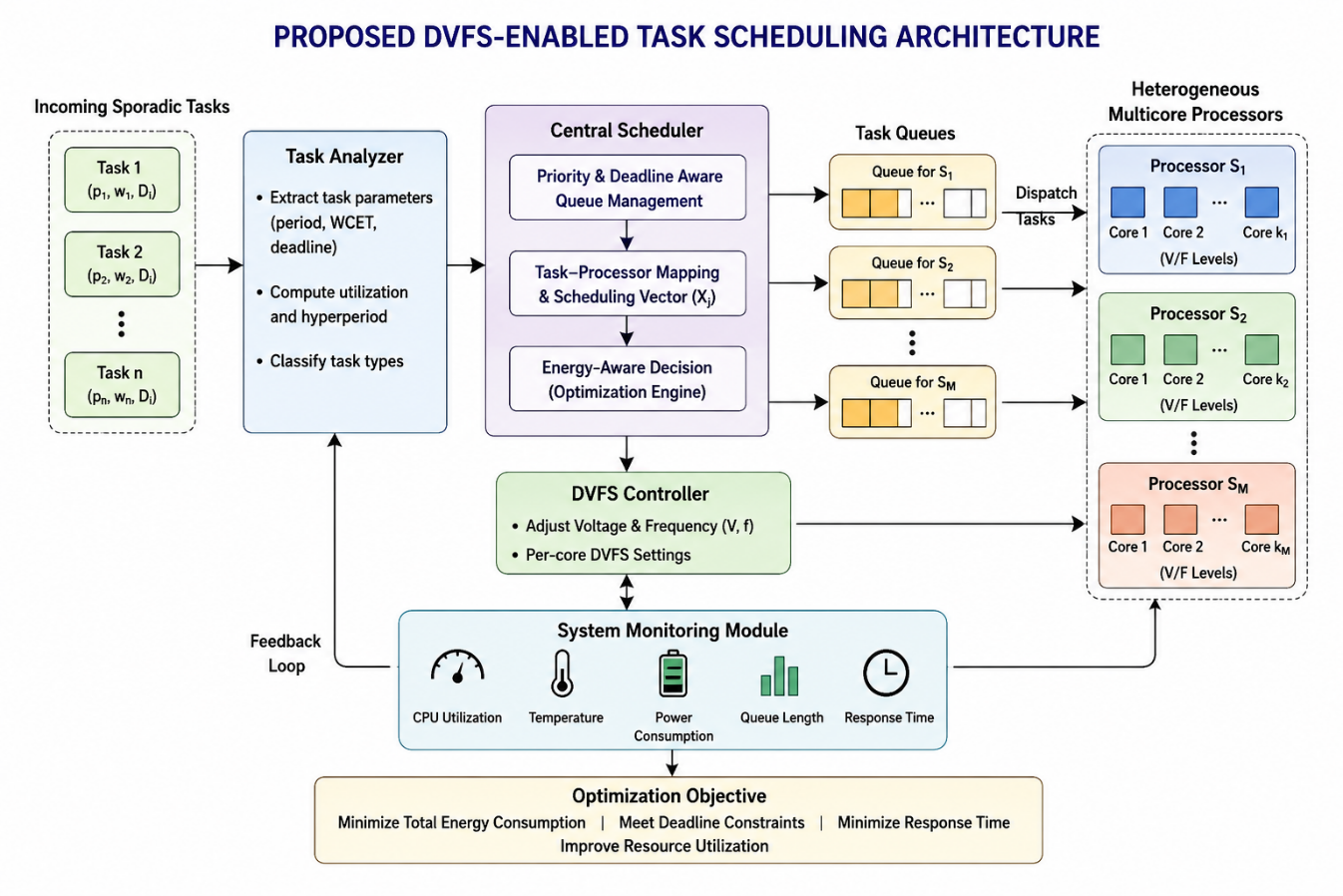
Dynamic Voltage and Frequency Scaling (DVFS) is a successful method to save energy in multi-core systems. However, if heterogeneous tasks having varying number of computations and time requirements are given to different cores, it is a big challenge to run those tasks on time with minimum energy consumption. If these tasks are not scheduled correctly, they can result in higher energy consumption, loss of resources, and compromised system performance. To overcome the aforementioned challenges, a task scheduling framework for multicore processor systems with DVFS is proposed in this work. The proposed architecture is based on an Adaptive DVFS control along with a central scheduling mechanism. First, tasks are analyzed as they are received to determine the time constraints and resources needed. The DVFS mechanism dynamically modifies the operating voltage and frequency of the processing cores depending on the processor configuration in order to provide energy efficient execution. The proposed scheduling strategy then distributes the tasks to the appropriate processor cores for efficient execution. The scheduling problem is modeled as an optimization problem which minimizes the total amount of energy used while meeting a task's deadlines. Moreover, the proposed approach consumes less queuing delay, which enhances the scheduling efficiency and reduces the execution latency. Experimental and comparative analysis results show that the proposed framework has higher energy efficiency and task scheduling effectiveness than the previous ones.
References
[1] Hajiaminia, S., & Shirazib, B. A. (2020). A study of DVFS methodologies for multicore systems with islanding feature. Advances in Computers, 119, 35.
[2] Kumbhare, N., Akoglu, A., Marathe, A., Hariri, S., & Abdulla, G. (2020). Dynamic power management for value-oriented schedulers in power-constrained HPC system. Parallel Computing, 102686.
[3] Attia, K. M., El-Hosseini, M. A., & Ali, H. A. (2017). Dynamic power management techniques in multi-core architectures: A survey study. Ain Shams Engineering Journal, 8(3), 445-456.
[4] Qin, Y., Zeng, G., Kurachi, R., Li, Y., Matsubara, Y., & Takada, H. (2019). Energy-efficient intra-task DVFSS scheduling using linear programming formulation. IEEE Access, 7, 30536-30547.
[5] Basireddy, K. R., Singh, A. K., Al-Hashimi, B. M., & Merrett, G. V. (2019). AdaMD: Adaptive mapping and DVFS for energy-efficient heterogeneous multi-cores. IEEE Transactions on Computer-Aided Design of Integrated Circuits and Systems.
[6] Mo, L., Kritikakou, A., & Sentieys, O. (2018). Energy-quality-time optimized task mapping on DVFS-enabled multicores. IEEE Transactions on Computer-Aided Design of Integrated Circuits and Systems, 37(11), 2428-2439.
[7] ul Islam, F. M. M., Lin, M., Yang, L. T., & Choo, K. K. R. (2018). Task aware hybrid DVFS for multi-core real-time systems using machine learning. Information Sciences, 433, 315-332.
[8] Gupta, M., Bhargava, L., & Indu, S. (2020). Dynamic workload-aware DVFS for multicore systems using machine learning. Computing, 1-23.
[9] Zhang, Q., Lin, M., Yang, L. T., Chen, Z., Khan, S. U., & Li, P. (2018). A double deep Q-learning model for energy-efficient edge scheduling. IEEE Transactions on Services Computing, 12(5), 739-749.
[10] Pagani, S., PD, S. M., Jantsch, A., & Henkel, J. (2018). Machine learning for power, energy, and thermal management on multi-core processors: A survey. IEEE Transactions on Computer-Aided Design of Integrated Circuits and Systems.
[11] Digalwar, M., Raveendran, B. K., & Mohan, S. (2017). LAMCS: A leakage aware DVFS based mixed task set scheduler for multi-core processors. Sustainable Computing: Informatics and Systems, 15, 63-81.
[12] Zhang, D., Guo, D., Chen, F., Wu, F., Wu, T., Cao, T., & Jin, S. (2012). TL-plane-based multi-core energy-efficient real-time scheduling algorithm for sporadic tasks. ACM Transactions on Architecture and Code Optimization (TACO), 8(4), 1-20.
[13] Kumar, N., & Vidyarthi, D. P. (2020). A novel energy-efficient scheduling model for multi-core systems. Cluster Computing, 1-24.
[14] Zand, H. V., Raji, M., Pedram, H., & SharifAbadi, H. H. (2020). A genetic algorithm-based tasks scheduling in multicore processors considering energy consumption. International Journal of Embedded Systems, 13(3), 264-273.
[15] Hajiamini, S., Shirazi, B., Crandall, A., & Ghasemzadeh, H. (2019). A dynamic programming framework for DVFS-based energy-efficiency in multicore systems. IEEE Transactions on Sustainable Computing, 5(1), 1-12.
[16] Choi, J., Jung, B., Choi, Y., & Son, S. (2017). An adaptive and integrated low-power framework for multicore mobile computing. Mobile Information Systems, 2017.
[17] Liu, J., Li, K., Zhu, D., Han, J., & Li, K. (2016). Minimizing cost of scheduling tasks on heterogeneous multicore embedded systems. ACM Transactions on Embedded Computing Systems (TECS), 16(2), 1-25.
[18] Bao, W., Hong, C., Chunduri, S., Krishnamoorthy, S., Pouchet, L. N., Rastello, F., & Sadayappan, P. (2016). Static and dynamic frequency scaling on multicore CPUs. ACM Transactions on Architecture and Code Optimization (TACO), 13(4), 1-26.
[19] Reddy, B. K., Singh, A. K., Biswas, D., Merrett, G. V., & Al-Hashimi, B. M. (2017). Inter-cluster thread-to-core mapping and DVFS on heterogeneous multi-cores. IEEE Transactions on Multi-Scale Computing Systems, 4(3), 369-382.
[20] Jeevitha, J. K., & Athisha, G. (2020). A novel scheduling approach to improve the energy efficiency in cloud computing data centers. Journal of Ambient Intelligence and Humanized Computing, 1-11.
[21] Maurya, A. K., Modi, K., Kumar, V., Naik, N. S., & Tripathi, A. K. (2020). Energy-aware scheduling using slack reclamation for cluster systems. Cluster Computing, 23(2), 911-923.
Downloads
Published
Data Availability Statement
Data can be provided on genuine request.
Issue
Section
License
Copyright (c) 2026 International Journal of Computational Intelligence in Engineering (IJCIE)

This work is licensed under a Creative Commons Attribution-ShareAlike 4.0 International License.