Modern Approaches to Lossless Compression: Entropy Coding, Transform Methods, and Deep Learning Models
DOI:
https://doi.org/10.5281/zenodo.20542410Keywords:
Image Compression, Lossless Compression, Neural Network Compression, Predictive Coding, Entropy CodingAbstract
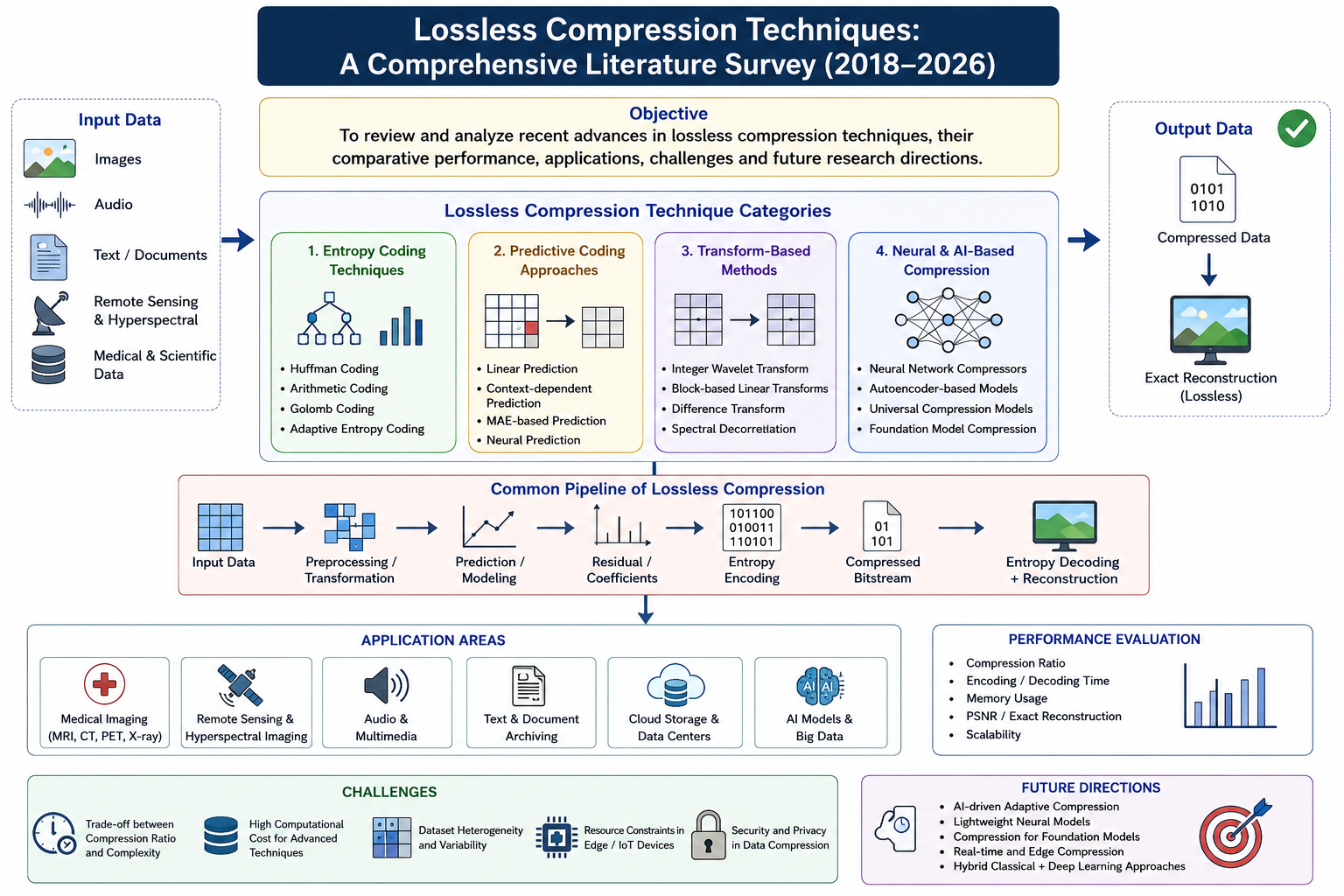
Digital data from multimedia systems, cloud computing, Internet of Things (IoT), medical imaging, remote sensing, and AI has grown exponentially, creating a need for effective data storage and transmission. Lossless compression plays an important part in minimizing storage requirements and communication bandwidth, and in providing a perfect reconstruction of the original data. Lossless compression does not discard any data, and is essential for certain applications, where data integrity and accuracy is paramount, including medical diagnostics, scientific computing, legal documentation, and hyperspectral imaging. In this paper, a detailed literature survey on the latest developments of the lossless compression technologies 2018-2026 is presented. Classical entropy based methods, predictive coding models, transform based compression, and new neural-network assisted compression frameworks are covered. Special focus is paid on medical image compression, hyperspectral image coding, audio compression, and compression of foundation models. Context dependent prediction, entropy-aware transformations, integer wavelet transforms and deep learning based universal compressors are critically examined and compared. In addition, the study underscores the increasing importance of artificial intelligence for improving the compression performance using adaptive learning and intelligent redundancy reduction techniques. Comparative evaluations show that the present machine learning based and neural network based methods can lead to better compression efficiency and still maintain the lossless reconstruction capability. Lastly, current challenges, emerging trends and future research directions are discussed, such as the application of edge computing, efficient compression strategies for large-scale foundation models and next-generation systems, and compression enabled by AI.
References
[1] A. J. Hussain, A. Al-Fayadh and N. Radi, “Image compression techniques: A survey in lossless and lossy algorithms,” Neurocomputing, vol. 300, pp. 44–69, 2018, doi: 10.1016/j.neucom.2018.02.094.
[2] M. A. Rahman and M. Hamada, “Lossless Image Compression Techniques: A State-of-the-Art Survey,” Symmetry, vol. 11, no. 10, p. 1274, 2019, doi: 10.3390/sym11101274.
[3] A. Altamimi and B. Ben Youssef, “Lossless and Near-Lossless Compression Algorithms for Remotely Sensed Hyperspectral Images,” Entropy, vol. 26, no. 4, p. 316, 2024, doi: 10.3390/e26040316.
[4] B. Žalik, D. Podgorelec, I. Kolingerová, D. Strnad and Š. Kohek, “A case study on entropy-aware block-based linear transforms for lossless image compression,” Scientific Reports, vol. 14, p. 29594, 2024, doi: 10.1038/s41598-024-79038-2.
[5] G. Ulacha and M. Łazoryszczak, “Lossless Image Compression Using Context-Dependent Linear Prediction Based on Mean Absolute Error Minimization,” Entropy, vol. 26, no. 12, p. 1115, 2024, doi: 10.3390/e26121115.
[6] R. Nagendran, S. Ramadass, K. Thilagavathi and A. Ravuri, “Lossless hyperspectral image compression by combining spectral decorrelation techniques with transform coding methods,” International Journal of Remote Sensing, vol. 45, no. 18, pp. 6226–6248, 2024, doi: 10.1080/01431161.2024.2388861.
[7] H. Sun, H. Ma, F. Ling, H. Xie, Y. Sun and L. Yi, “A survey and benchmark evaluation for neural-network-based lossless universal compressors toward multi-source data,” Frontiers of Computer Science, vol. 19, p. 197360, 2025, doi: 10.1007/s11704-024-40300-5.
[8] M. Hershcovitch, L. Choshen, A. Wood, I. Enmouri, P. Chin, S. Sundararaman and D. Harnik, “Lossless and Near-Lossless Compression for Foundation Models,” arXiv Preprint, 2024, doi: 10.48550/arXiv.2404.15198.
[9] N. Sharma and U. Batra, “Performance analysis of compression algorithms for information security: A Review,” EAI Endorsed Transactions on Scalable Information Systems, vol. 7, no. 27, 2020, doi: 10.4108/eai.13-7-2018.163503.
[10] V.-I. Ungureanu, P. Negirla and A. Korodi, “Image-Compression Techniques: Classical and Region-of-Interest-Based Approaches Presented in Recent Papers,” Sensors, vol. 24, no. 3, p. 791, 2024, doi: 10.3390/s24030791.
[11] G. Xin and P. Fan, “A lossless compression method for multi-component medical images based on big data mining,” Scientific Reports, vol. 11, art. no. 12372, 2021, doi: 10.1038/s41598-021-91920-x.
[12] H. Rhee, Y. I. Jang, S. Kim and N. I. Cho, “Lossless Image Compression by Joint Prediction of Pixel and Context Using Duplex Neural Networks,” IEEE Access, vol. 9, pp. 118830–118841, 2021, doi: 10.1109/ACCESS.2021.3088936.
[13] M. A. Rahman, M. Hamada, M. A. Ali and M. F. I. Amin, “An Integer Wavelet Transform Based Lossless Image Compression Technique Using Arithmetic Coding,” in Frontiers in Artificial Intelligence and Applications, 2022, doi: 10.3233/FAIA220237.
[14] R. Rojas-Hernández, J. L. Díaz-de-León-Santiago, G. Barceló-Alonso, J. Bautista-López, V. Trujillo-Mora and J. C. Salgado-Ramírez, “Lossless Medical Image Compression by Using Difference Transform,” Entropy, vol. 24, no. 7, p. 951, 2022, doi: 10.3390/e24070951.
[15] A. Rajput, J. Li, F. Akhtar, Z. H. Khand, J. C. Hung, Y. Pei and A. Börner, “A Content Awareness Module for Predictive Lossless Image Compression to Achieve High Throughput Data Sharing over Network Storage,” International Journal of Distributed Sensor Networks, vol. 18, no. 4, 2022, doi: 10.1177/15501329221083168.
[16] T. Mineo and H. Shouno, “Improving Sign-Algorithm Convergence Rate Using Natural Gradient for Lossless Audio Compression,” EURASIP Journal on Audio, Speech, and Music Processing, vol. 2022, art. no. 12, 2022, doi: 10.1186/s13636-022-00243-w.
[17] H. Sun, H. Ma, F. Ling, H. Xie, Y. Sun and L. Yi, “A Survey and Benchmark Evaluation for Neural-Network-Based Lossless Universal Compressors Toward Multi-Source Data,” Frontiers of Computer Science, vol. 19, 2025, doi: 10.1007/s11704-024-40300-5.
[18] M. Hershcovitch, L. Choshen, A. Wood, I. Enmouri, P. Chin, S. Sundararaman and D. Harnik, “Lossless and Near-Lossless Compression for Foundation Models,” arXiv Preprint, 2024, doi: 10.48550/arXiv.2404.15198.
Downloads
Published
Data Availability Statement
Data availability is not applicable to this paper as no new data were created or analyzed in this study
Issue
Section
License
Copyright (c) 2026 International Journal of Computational Intelligence in Engineering (IJCIE)

This work is licensed under a Creative Commons Attribution-ShareAlike 4.0 International License.